
"It has always been fascinating for me to explore the psychology of people’s relationships with each other and with the outside world, to give shape to human emotions. To take joy, despondency, indifference, rapture and jealousy to pieces. Feelings are abstract, therefore it is so interesting to look for and find the form of their visualization."
"A passion for classical art and interest in everything new – technology, discoveries, experiments – led me to the type of mixed media, with which I work. From painting, I take colors and create air as an element of space. Reality and character I take from photography. My style originates from a long artistic tradition – collage. That is how my characters and spaces come together. At the next stage, I choose a brush of a graphics program. This is a subtle and accurate tool to create a light, weightless atmosphere similar to that of a dream. In my creative work, I am not searching for the subjects of thought. They spring from everyday life and observations of the people around. Choosing a motif for my exploration, I offer the audience a female view on things, which concern me. Undoubtedly, this view is based on feminist principles. Yet, the matter is not in confrontation, but in balance and harmony, where a woman is not an object, but foremost – energy."

"Repast is an allegory of life cycles. Cyclicity perfectly characterizes humanity and our perception of time.
The Morning (childhood) means acquisition and accumulation. At the beginning of life we receive a certain foundation and potency both from our family and from the society in which we live. We learn to recognize the beauty around us and to feel it — we use all this for the rest of our lives. Even if “breakfast” is sparse in physical reality, it is often filled to the brim with intangible treasures such as love, fantasy, discoveries, strong impressions and first disappointments. In “breakfast” the abundance of dairy products is symbolic. The milk is associated with purity and virginity. The memories of breast milk are still fresh. The fullness you see is an exaggeration. The yellow of orange juice symbolizes concentrated emotions, the taste of life, sincere joy, and the energy of children. A lemon or an orange signifies the unquenchable thirst for action, knowledge, and discovery.
The Morning (childhood) means acquisition and accumulation. At the beginning of life we receive a certain foundation and potency both from our family and from the society in which we live. We learn to recognize the beauty around us and to feel it — we use all this for the rest of our lives. Even if “breakfast” is sparse in physical reality, it is often filled to the brim with intangible treasures such as love, fantasy, discoveries, strong impressions and first disappointments. In “breakfast” the abundance of dairy products is symbolic. The milk is associated with purity and virginity. The memories of breast milk are still fresh. The fullness you see is an exaggeration. The yellow of orange juice symbolizes concentrated emotions, the taste of life, sincere joy, and the energy of children. A lemon or an orange signifies the unquenchable thirst for action, knowledge, and discovery.
The Day (youth, adulthood) — creation, destruction, giving and taking. The flesh (the fruit) and the colour red are symbols of life and sacrifice. Youth is a period of expending — some build, others destroy. “Time to throw stones and gather stones” — there is a balance in this. We all make sacrifices and give everything at this point in our lives. More or less.
The Evening (age, completion) — contemplation, silence. A meditative part. Scarcity of dinner does not mean scarcity of life, or poverty. The table is set for one person. We come alone to the end of our lives, and yet we merge face to face with the divine in this world. It is a time of transition where all matter fades and loses all meaning. I believe our spirit reaches its peak here and we either accept or reject this transition completely. The set of elements depicted is simple: the fish is the symbol of Christ, the potato (the second bread) — the body losing the spirit (steam), the black tea — the drink of the gods and sages, not for simple thirst quenching, but for contemplation. The position of the hands in the triptych refers to Leonardo da Vinci's “Last Supper”, in which the master emphasized the hands. Here they recede into the background and invite the viewer into this or that phase of life — past or future."
The Evening (age, completion) — contemplation, silence. A meditative part. Scarcity of dinner does not mean scarcity of life, or poverty. The table is set for one person. We come alone to the end of our lives, and yet we merge face to face with the divine in this world. It is a time of transition where all matter fades and loses all meaning. I believe our spirit reaches its peak here and we either accept or reject this transition completely. The set of elements depicted is simple: the fish is the symbol of Christ, the potato (the second bread) — the body losing the spirit (steam), the black tea — the drink of the gods and sages, not for simple thirst quenching, but for contemplation. The position of the hands in the triptych refers to Leonardo da Vinci's “Last Supper”, in which the master emphasized the hands. Here they recede into the background and invite the viewer into this or that phase of life — past or future."

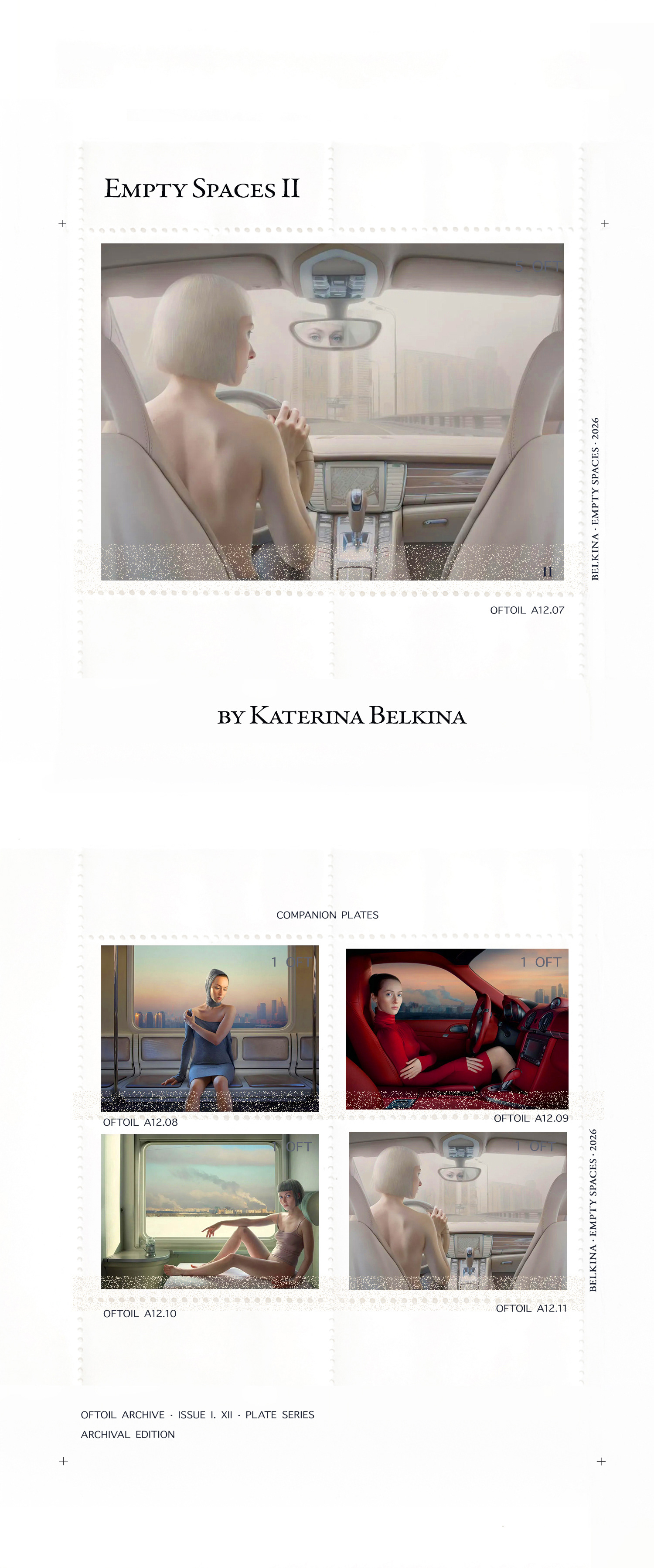
"When I was a small child, I was haunted by a recurring nightmare:
I wander the streets and get lost, looking for my house and cannot find it. All houses seem the same to me, only insignificant details distinguish them from each other — I am searching forever. There is nobody around me. Emptiness. I am alone.
The series Empty Spaces accompanies the person searching for a “comfortable place” — a place they can call their home. In this world full of ambiguity, a person does not want to be a guest, but to claim their own space in the universe for themselves. A new type of person is emerging who loves big cities and hates them at the same time.
I wander the streets and get lost, looking for my house and cannot find it. All houses seem the same to me, only insignificant details distinguish them from each other — I am searching forever. There is nobody around me. Emptiness. I am alone.
The series Empty Spaces accompanies the person searching for a “comfortable place” — a place they can call their home. In this world full of ambiguity, a person does not want to be a guest, but to claim their own space in the universe for themselves. A new type of person is emerging who loves big cities and hates them at the same time.
The city is made up of unnatural matter that has become inseparably connected with the human soul to form a new entity. The bigger a megalopolis is, the stronger its attraction. It is a powerful energy, indeed an impressive artificial intelligence, and without the human being it is just an empty shell. Such an emptiness also exists within us and demands to be filled. And we fill it. With matter. In big, bright, shining cities we often feel cold loneliness and helplessness. Behind the perpetual movement and hurry we discover the emptiness repeatedly. Achievements are illusory, benefits — deceptive. The slight suspicion arises that we should not be here."

"I dream about space, about planets and universes. It is always about the future, about romance and excitement for me. Yet, at the same time, I am also rooted in the here and now and think about my home - planet Earth. What's wrong with me? What's wrong with the human beings on this Earth? There is so much suffering everywhere that people do not want to be where they are, they believe that there must be a better world somewhere. What difference can a single citizen of the earth make? One singular, microscopic human being cannot solve anything.
But our mind is its own universe, different for every single one of us. And in this universe, we can create our own reality, our own phantoms, which become the reasons for our decisions, for our actions, and ultimately for our historical facts. Now, in yet another difficult moment in our history, I dare to imagine that each of us can find comfort in our own imaginary space full of planets, stars and even galaxies that we ourselves have created. After all, we were born to live in space, and indeed, we do.
But our mind is its own universe, different for every single one of us. And in this universe, we can create our own reality, our own phantoms, which become the reasons for our decisions, for our actions, and ultimately for our historical facts. Now, in yet another difficult moment in our history, I dare to imagine that each of us can find comfort in our own imaginary space full of planets, stars and even galaxies that we ourselves have created. After all, we were born to live in space, and indeed, we do.
I walk around my house collecting all kinds of things that have nothing to do with each other: simple materials, paper, stones, even flour. I find a little corner by the window and build a strange, imaginary and alien landscape there in this nook. Little by little it becomes real. I arrange one of my chosen planets. I will place myself on that one. Another one is placed in my arms. I will endow it with the essence. As if there are two equivalent cosmic bodies: something outside our atmosphere that is powerful and influential, ruling tides and people and our personal one - our own totem.
I try to overcome my fears by focusing on timelessness and at the same time on the moment in its impermanence. We often miss out on being in the moment because we are so busy living our lives. But being in the moment is perfect for marveling at life. And being here reminds me that I can stop time at any time; that any of us can if we want to. It may be hard, but it is so simple."
I try to overcome my fears by focusing on timelessness and at the same time on the moment in its impermanence. We often miss out on being in the moment because we are so busy living our lives. But being in the moment is perfect for marveling at life. And being here reminds me that I can stop time at any time; that any of us can if we want to. It may be hard, but it is so simple."
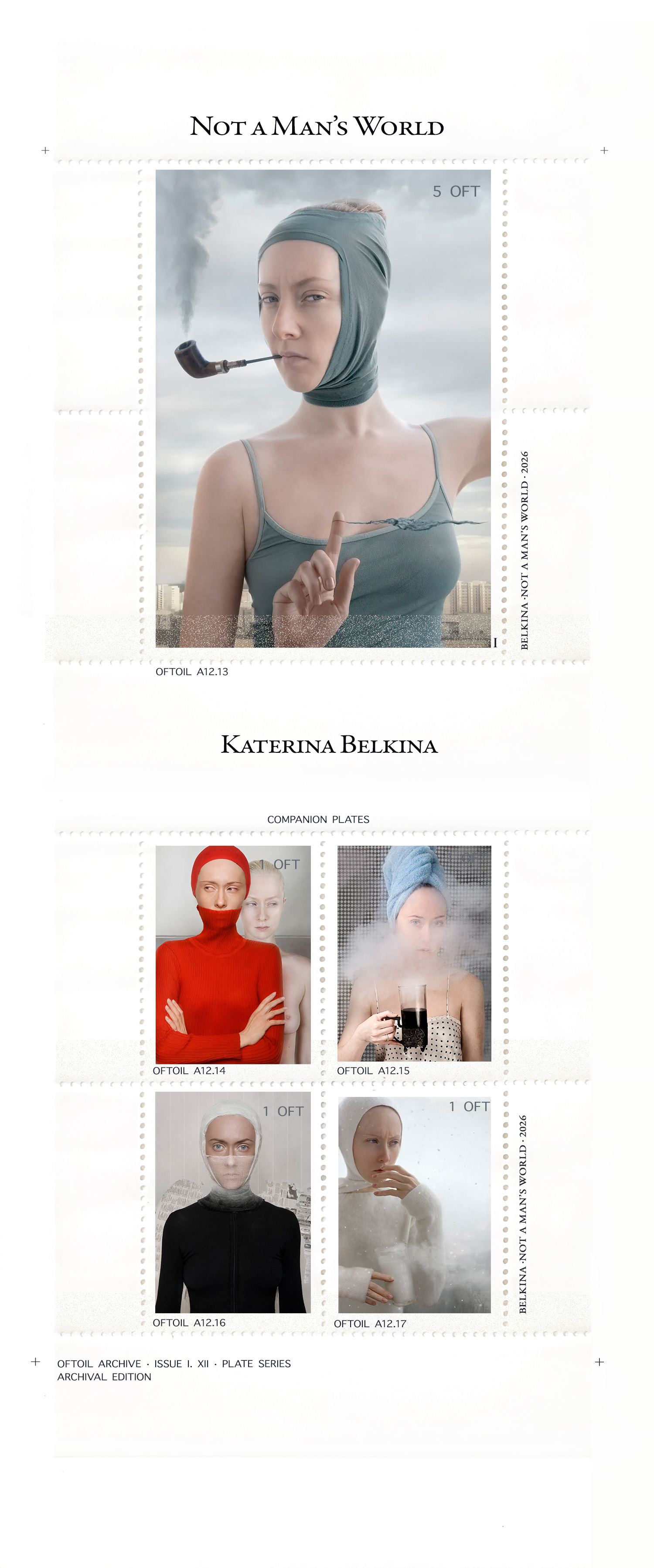
"This is not a man’s world. Sometimes it is only understood by women, yet sometimes it interacts very closely with the male world. Until recently, society was divided into these two poles. Now the boundaries are erased in some places, in others they remain clear. Despite the fact that the essence of women is well understood and familiar to me on a deep level, as an artist I try to abstract from this knowledge and imagine that I am seeing a woman for the first time. I want to dissect her subconscious. For this I have taken the liberty of being other women — different in character and fate.
In each of them we recognize one of the heroines we know from fairy tales and at the same time we recall the different psyches of women in modern society.
I transform into them and put on costumes and masks, only following the old universal practice of women who must take on a different role every day of their lives — being a wife or lover, a mother or daughter. As a woman I can be vicious and innocent, strong, and weak, aggressive, and gentle — and that is perfectly fine. Each of the heroines represents one of our feelings: jealousy, envy, drowning, or disappointment, and so on."
I transform into them and put on costumes and masks, only following the old universal practice of women who must take on a different role every day of their lives — being a wife or lover, a mother or daughter. As a woman I can be vicious and innocent, strong, and weak, aggressive, and gentle — and that is perfectly fine. Each of the heroines represents one of our feelings: jealousy, envy, drowning, or disappointment, and so on."

"A Zweiraumwohnung is not just the most common type of city home; it also represents a coordinate system for a typical urbanite. I spent more than half my life in two-room apartments. The world is becoming more open for doing business, communicating, traveling, and establishing connections, and yet our life is becoming more and more secluded. It seems compressed to the size of a small apartment. The body’s range of movement is limited to one or two rooms and the path between them. Each day starts with a certain ritualized sequence of actions. The mind simultaneously solves global world political conflicts, participates in information and real wars, experiences economic crises, travels around the world, communicates with people from all over the world, and processes a ton of information about people and places we do not know. It goes around the world and communicates with others, regardless of physical distance. We often participate passively in the life of the world community, and our participation has no geographical limitations, unlike us. It is precisely this dissonance that increasingly divides us into two separate spaces — the mind and the body.
The photographs which formed the basis for every single work of the project were taken in either one or the other corner of my apartment, where I spend most of my daily life. In the video for the project, you can observe all the daily and inconspicuous activities of mine, which even I would say appear as if seen through the window of the house opposite. Listen to the latest news in the background after all the hustle and bustle, or a short five-minute meditation track! Like an astronaut on a spaceship, I wake up and start my daily routine: I work, get my chores done, look after my family, and then I am out on my spacewalk into orbit on the Internet, connecting to the rest of the world and able to calm down while absorbing information, watching the lives of the others, thinking about serious social issues. It is so trivial and so strange at the same time. Thirty years ago, the world was a completely different place. This period seems a turning point."
About the artist:
Early on Katerina Belkina knew about her exceptional talent to see the world through different eyes. Born in Samara in the southeast of European Russia, she was brought up in an creative atmosphere by her mother, a visual artist. Her education as painter at the Art Academy and from 2000 at the school for Photography of Michael Musorin in Samara gave her the tools to visualize her ideas. Exhibitions of her sublime, mystic self-portraits ensued in Moscow and Paris. In 2007 Katerina Belkina was nominated for the prestigious Kandinsky Prize (comparable to the British Turner Prize) in Moscow. Recently she got the Hasselblad Masters Prize. Currently she lives and works in Dresden.
Images & words courtesy of Katerina Belkina


