“The ultimate aim of all creative activity is the building.”
— Bauhaus
— Bauhaus
Founded in Weimar in 1919 by Walter Gropius, the Bauhaus was never merely a school. It was a proposition: that art, industry, architecture, typography, furniture, theatre, and daily life could be reorganized into a single modern language.
More than a century later, its visual grammar remains permanently embedded within contemporary culture.
The Bauhaus in Design Plate Series traces not the institution itself, but its afterimage — the migration of Bauhaus principles across generations of designers, illustrators, typographers, and digital practitioners. Geometry becomes rhythm. Transparency becomes movement. Primary colors dissolve into gradients, systems, and optical interference. What once belonged to modernism now behaves like visual memory.
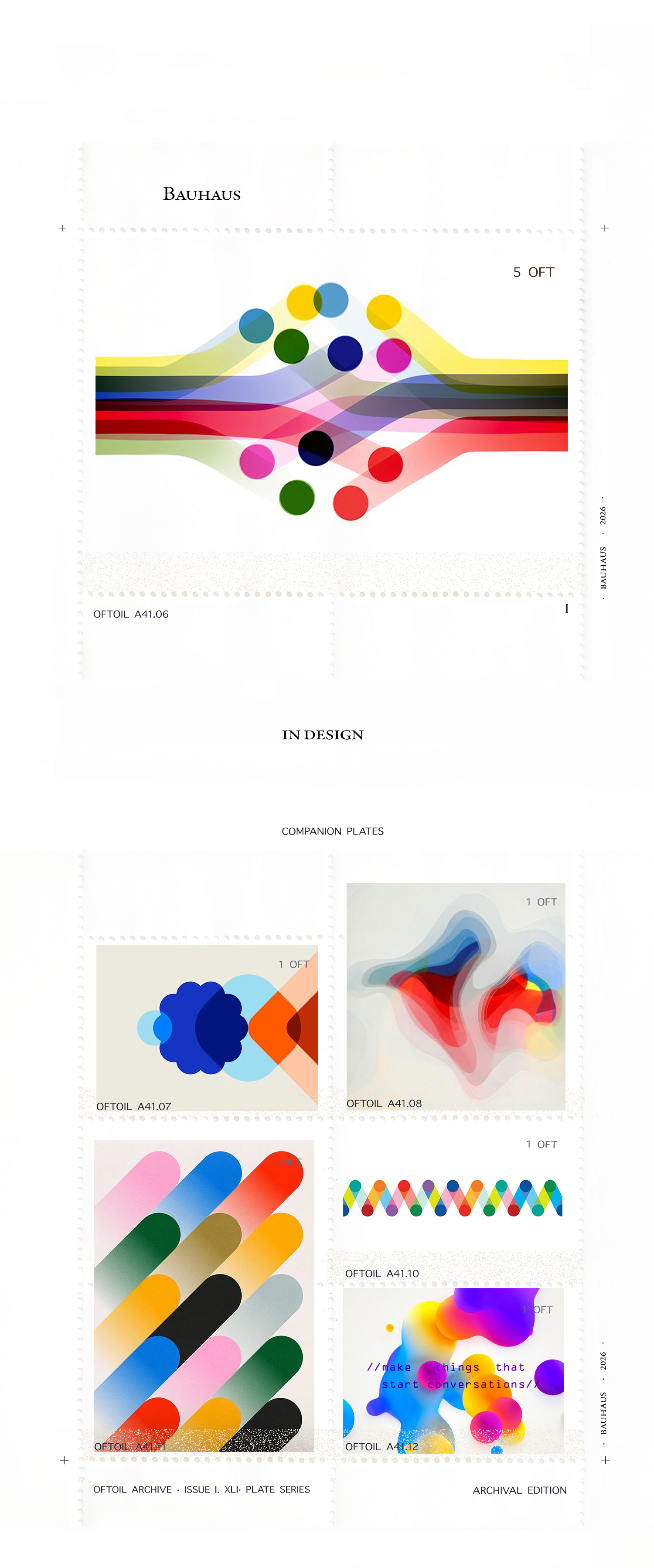
Across the archive, circles intersect like mechanical eclipses, modular forms repeat with musical precision, and abstraction drifts between strict order and playful instability. The Companion Plates reveal how Bauhaus survives not through imitation, but through perpetual reinterpretation.
late A41.01 recalls Josef Albers-like chromatic studies through translucent circular overlays, transforming color into spatial vibration.
Plate A41.06 expands Bauhaus geometry into fluid motion graphics, where linear systems blur into spectral movement and layered transparency.
Plate A41.13 revisits the iconic Bauhaus typographic identity through angular modular construction, echoing early modernist poster experiments and exhibition graphics.
Plate A41.06 expands Bauhaus geometry into fluid motion graphics, where linear systems blur into spectral movement and layered transparency.
Plate A41.13 revisits the iconic Bauhaus typographic identity through angular modular construction, echoing early modernist poster experiments and exhibition graphics.
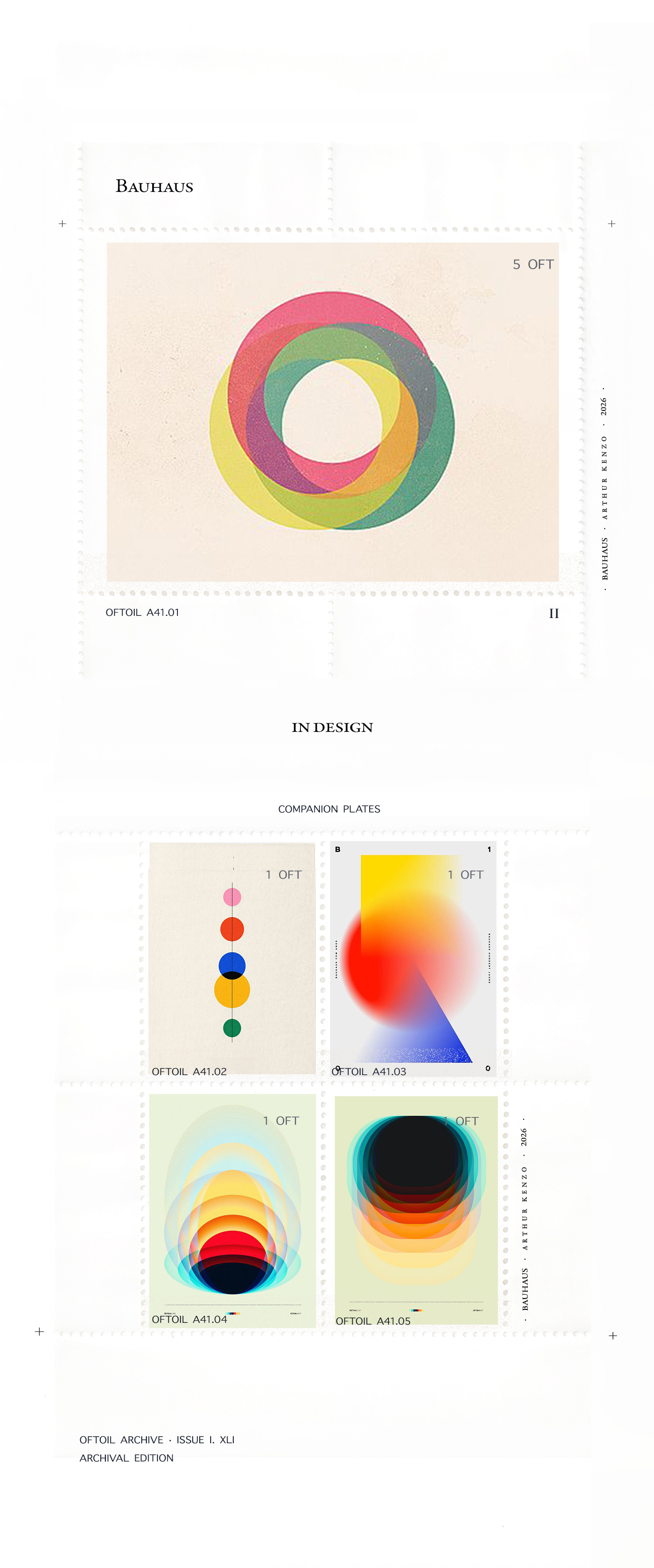
Additional Companion Plates reference the visual legacy of figures including Wassily Kandinsky, Paul Klee, László Moholy-Nagy, and Herbert Bayer — though filtered through contemporary digital aesthetics, soft gradients, algorithmic repetition, and post-print abstraction.
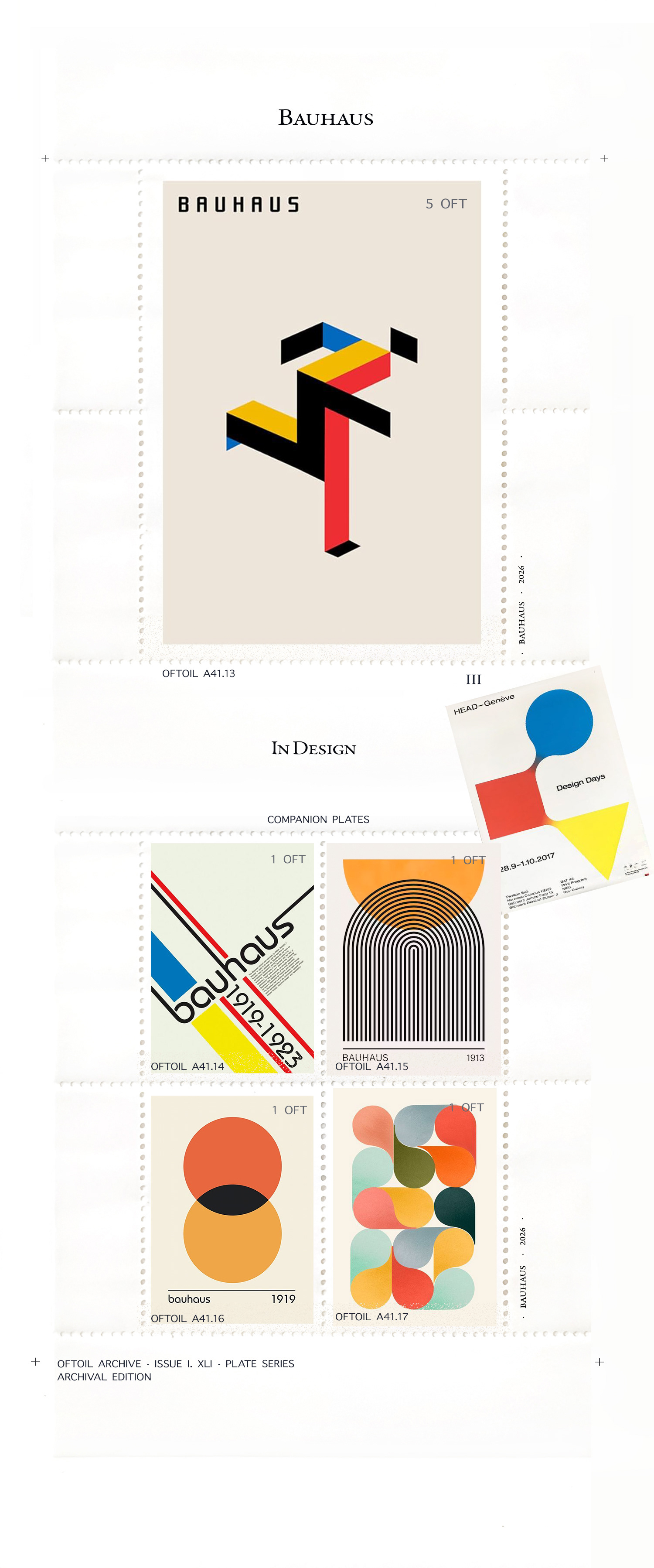
Within the OfToil Archive, these plates function as typographic fossils and living studies simultaneously: evidence of a design language that never ceased evolving.
The collection preserves Bauhaus not as nostalgia, but as an active operating system for modern visual culture.
Archival Note
Collectible Plate Series A41 documents the continued mutation of Bauhaus principles across contemporary graphic practice — where geometry, color theory, reduction, and modular structure persist beyond the school itself, re-emerging endlessly through new media, technologies, and visual generations.
Collectible Plate Series A41 documents the continued mutation of Bauhaus principles across contemporary graphic practice — where geometry, color theory, reduction, and modular structure persist beyond the school itself, re-emerging endlessly through new media, technologies, and visual generations.
Images courtesy of respective owners.