“Architecture begins when two bricks are carefully put together.”
— Ludwig Mies van der Rohe (Rothschild)
— Ludwig Mies van der Rohe (Rothschild)
“God is in the details.”
“Less is more.”
“Be simple and then continue to be simple.”
Few designers have dissolved the boundary between furniture and architecture as completely as Ludwig Mies van der Rohe. His work reduced form to discipline, proportion, and the eloquence of structure. Steel was bent into line, leather suspended like calm skin, glass lifted into civic ritual. What appears effortless in Mies is never casual; every junction carries the weight of decision.
These three plates trace that rare continuity of thought. The cantilever chair transforms modern industry into seated lightness. The Barcelona Chair gives ceremony to rest, converting a throne into modern repose. The Neue Nationalgalerie extends the same language to the scale of the city: roof, column, glass, void. Across object and building alike, Mies pursued an order in which nothing could be removed without loss.
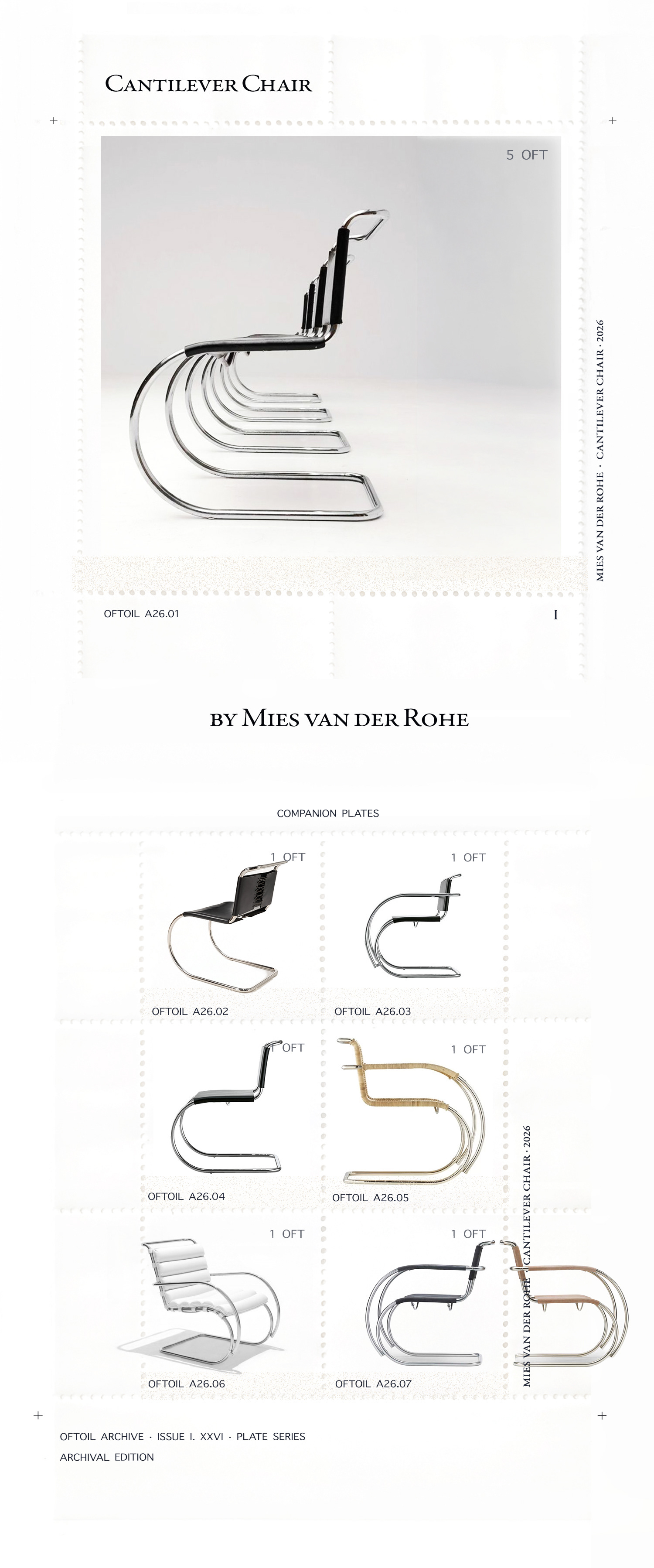
The cantilever chair remains one of modern design’s decisive gestures: the removal of the rear legs, and with them centuries of inherited expectation. Tubular steel, newly associated with bicycles, factories, and speed, becomes elastic architecture. The sitter is held not by bulk but by tensile grace.
In this form, engineering becomes poise. The line curves forward, returns to ground, and suspends the body in a controlled spring.
It is a chair that appears to breathe under weight.
What others treated as furniture, Mies treated as structure reduced to necessity.
The companion studies reveal variation without betrayal—different backs, woven cane, upholstered ease, polished severity. Each iteration confirms the same proposition: comfort may arise from precision.
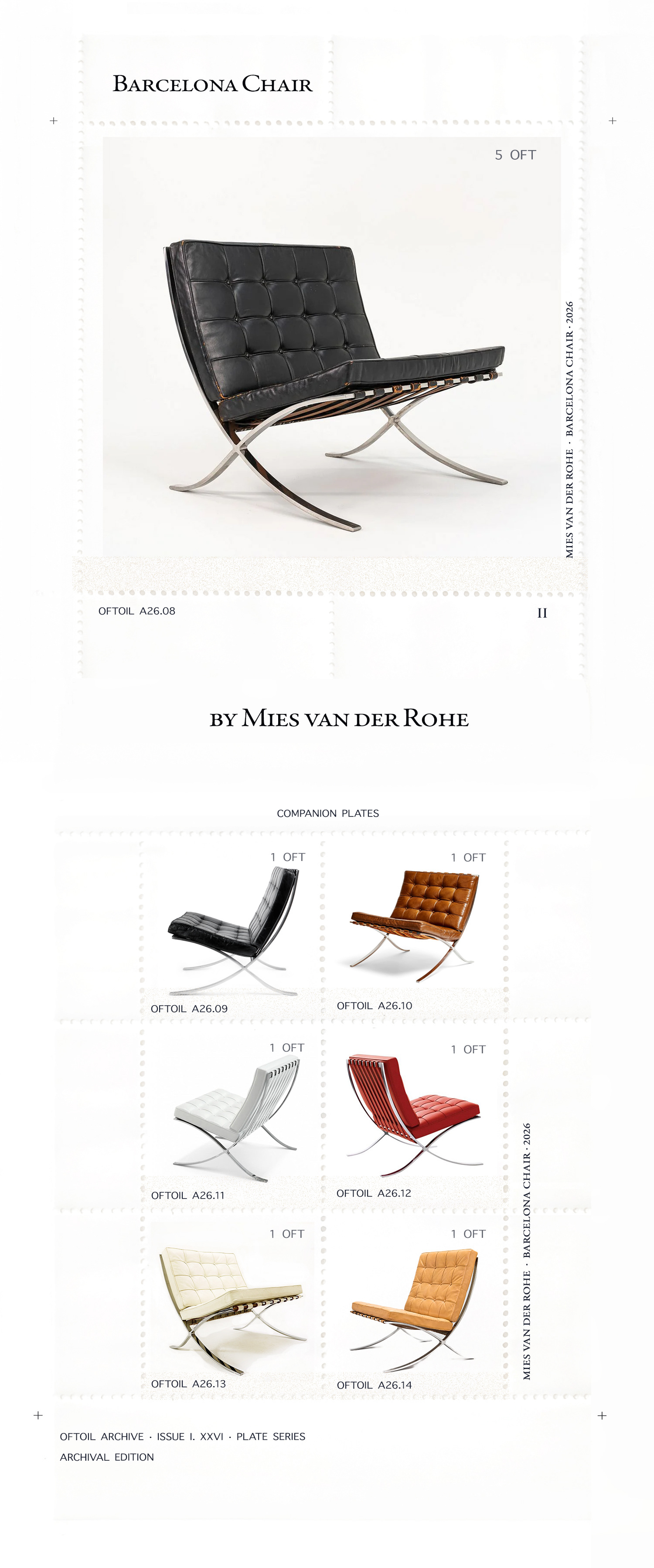
Designed for the International Exposition of 1929 and the German Pavilion, the Barcelona Chair is among the clearest emblems of modern luxury. It carries the memory of curule thrones and ceremonial seating, yet strips them of ornament until only authority of proportion remains.
Crossed steel supports create a disciplined base; hand-tufted cushions introduce tactility without excess. It is sumptuous, though never indulgent. The object understands that elegance depends less on richness than restraint.
Seen through its many finishes—black, ivory, tan, oxblood—the chair proves its resilience. Color changes; the idea does not. Few objects have moved so fluently between palace, gallery, office, and private room while retaining their silence.
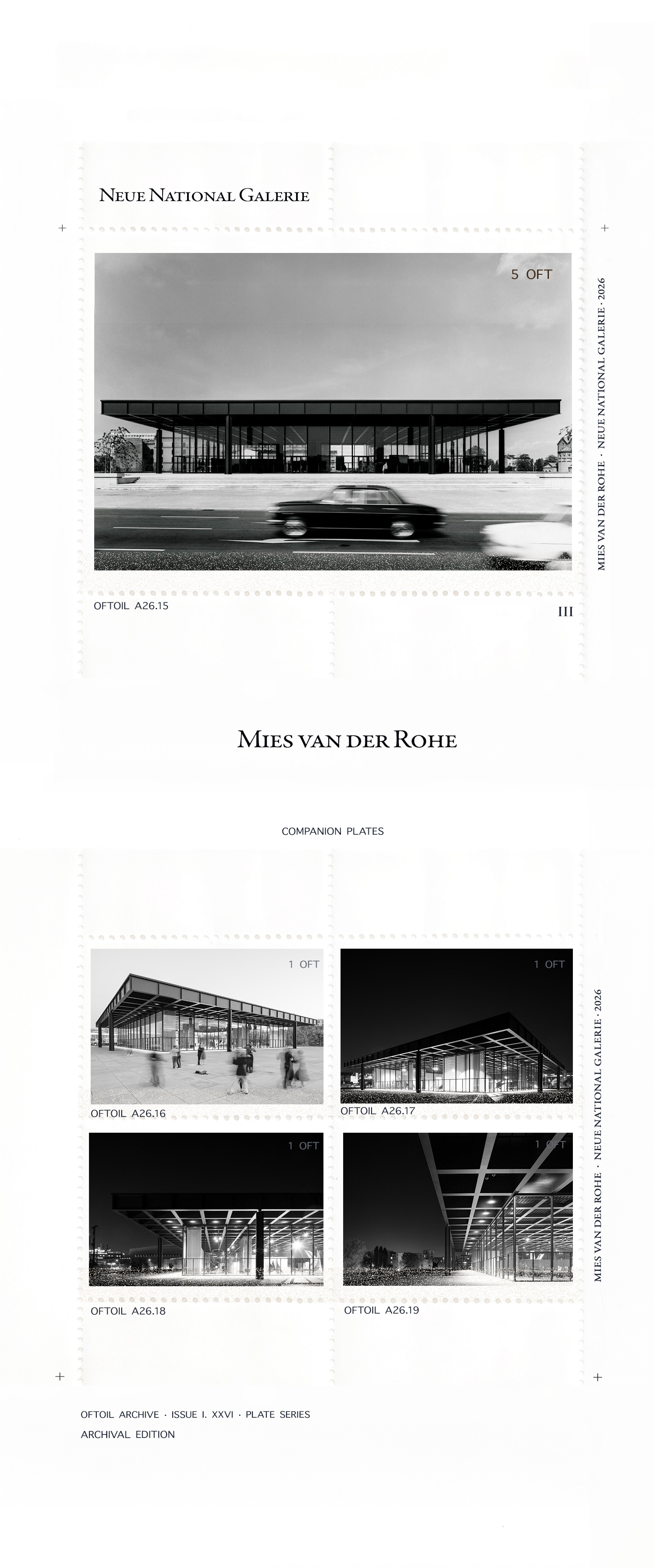
Completed in Berlin in 1968, the Neue Nationalgalerie stands as Mies’s late testament: a square roof plane held above glass walls, an immense room offered to the city with almost impossible calm. It is both museum and proposition.
The building has long been admired for purity and criticized for practicality. Exhibition walls were scarce, climate difficult, scale uncompromising. Yet these tensions are inseparable from its power.
Mies pursued universal space with such conviction that function was asked to adapt itself to form.
Recent restoration by David Chipperfield treated the structure less as renovation than conservation—an acknowledgment that some buildings exceed use and enter the realm of cultural instruments. By day it reflects Berlin; by night it glows like an abstract lantern. It remains one of the twentieth century’s most exacting public rooms.
Taken together, the works resist conclusion.
Across these plates, Mies van der Rohe demonstrates a singular continuity of mind: the chair as building, the building as chair. Tubular steel, stitched leather, granite podium, blackened column—different materials governed by one ethic. His legacy is not minimalism as style, but reduction as rigor. To encounter Mies is to see how much presence can be made from almost nothing.
Images and words courtesy of