
“Colour is not a thing in itself. It exists through perception.”
— Olafur Eliasson
Olafur Eliasson treats perception as material. Light, reflection, transparency, and geometry become instruments through which space is not merely observed, but continuously produced by the viewer. His works do not stabilize into fixed images; they shift with movement, angle, duration, and atmosphere.
Across these plates, circles recur as orbital forms — lenses, suns, mirrors, planetary fragments suspended between science and sensation. Colour behaves architecturally: layered, filtered, refracted into temporary alignments. The compositions appear precise, yet remain unstable, always completing themselves through the act of looking.
In archival form, these works resemble diagrams from an imagined cosmology — collectible studies in light, rhythm, and spatial consciousness. Each plate preserves not an object alone, but a condition of seeing.

The visual ambiguity created by an ellipse is a theme Eliasson has explored repeatedly over the years. The mechanism is beguilingly simple: an ellipse appears to be a circle viewed in perspective, and a sequence of ellipses creates the illusion of a disc rotating in space. For this work, the hand-blown coloured glass mirrors have been organised in a ring that progresses from circles to flattened ellipses and back again.
The appearance of transparency where the segments overlap is simulated by inserting glass panes of slightly different shades, and the arrangement of tones corresponds to the colour wheel of primary and secondary colours well known from art history, picking up on Eliasson’s ongoing investigation of colour theory in other media.
Colour unfolds as trajectory. Elliptical planes overlap like orbital paths suspended mid-rotation, producing gradients that seem to breathe through transparency itself.
The composition recalls astronomical notation while remaining deeply physical: glass as atmosphere, pigment as movement, light as structure.
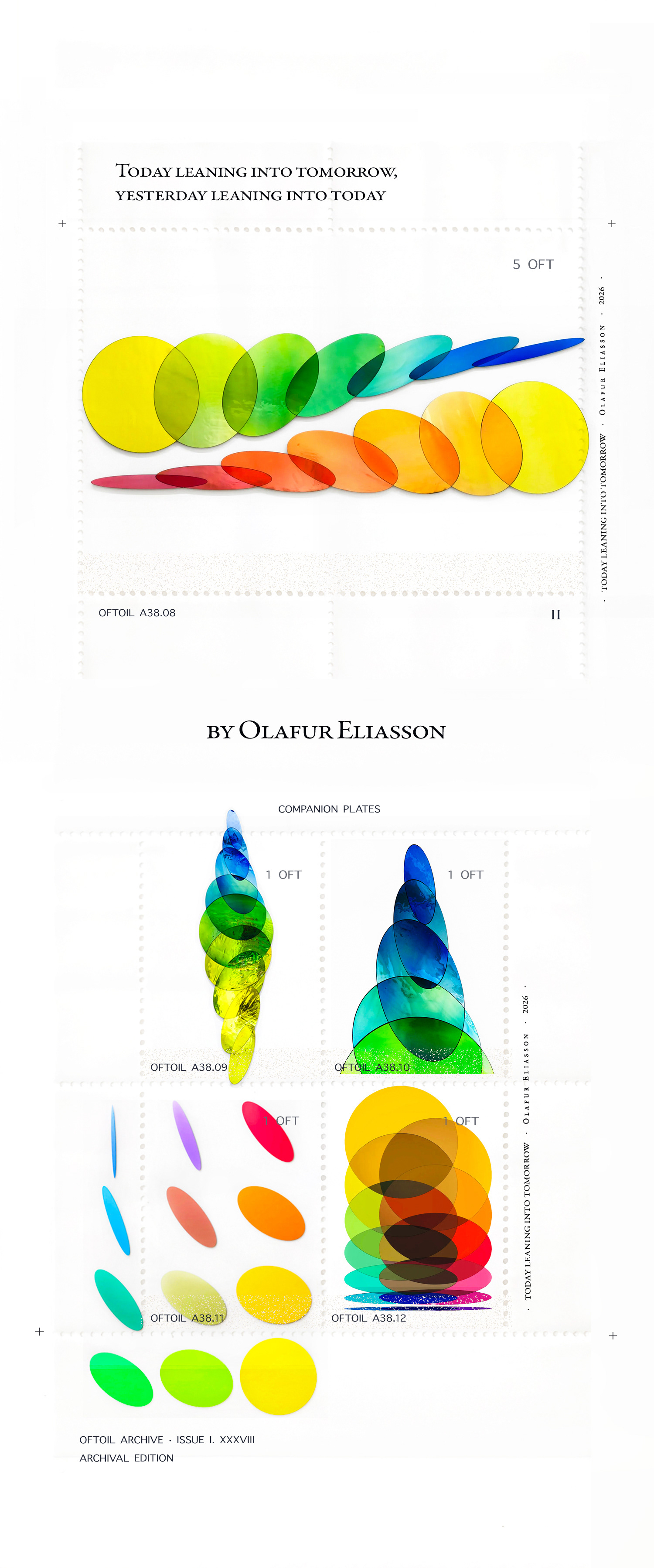
Two rows of glass ellipses hang on a wall, one above the other. Each presents a progression of seven, overlapping ellipses that transition from flat, elongated shapes to round circles. The rows develop in opposing directions in the top and bottom row, creating a kind of symmetry and balance between the two. The colours of the ellipses transition through the major hues of the subtractive colour model, from yellow to green to cyan above, and from yellow to orange to red and magenta below. Intermediary tones have been used wherever the ellipses overlap to create an illusion of transparency and enhance the sense of motion.
Eliasson has long been inspired by the inherent visual confusion of the ellipse, which, depending on the context, can produce an illusion of a circular disc viewed in perspective. Here, the ellipses shift simultaneously upon their axes, creating the sense that the disc is rotating and tumbling at the same time.
The backs of the glass panes are silvered, reflecting the viewers and their surroundings in the particular monochromatic tone of the glass. Ripples and bubbles in the handblown glass enhance the fluidity of the work.
The backs of the glass panes are silvered, reflecting the viewers and their surroundings in the particular monochromatic tone of the glass. Ripples and bubbles in the handblown glass enhance the fluidity of the work.
Time is rendered chromatically. The sequence behaves less like sculpture than accumulation — moments stacked, tilted, and partially eclipsed by one another. Past and future become simultaneous surfaces, touching through colour and repetition.
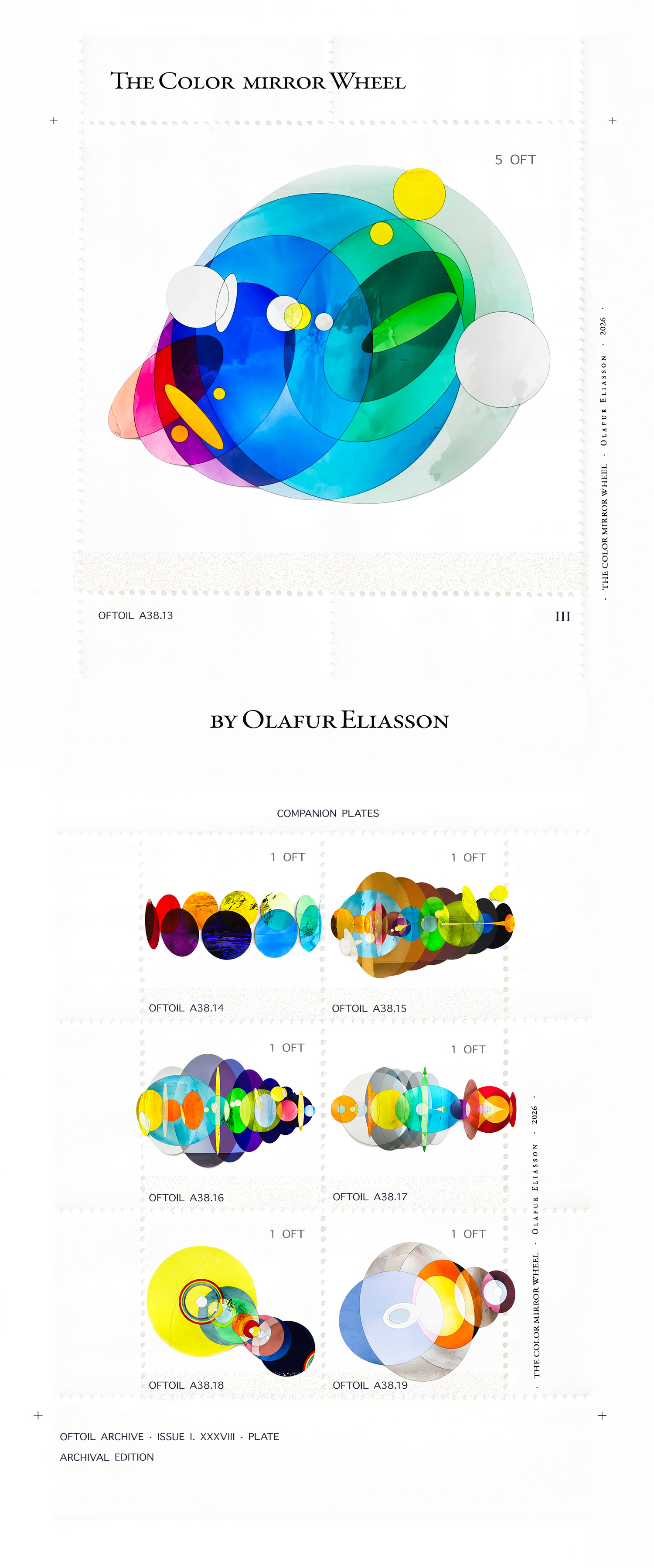
Colour mirror wheel continues Eliasson’s exploration of the visual ambiguity between an ellipse viewed head on and a circle viewed from an oblique angle. This work, made from hand-blown glass mirrors, suggests a three-dimensional ring made of discs whose colours progress, like those of a rainbow, through the spectrum of visible light. The effect produced by overlaid layers of transparent colour is one of Eliasson’s recurring interests; the appearance of transparency in Colour mirror wheel is simulated by panes of glass with subtly different hues.
Reflection becomes multiplicity. Circular forms collide into shifting perceptual events where boundaries dissolve between mirror, lens, and void. The work transforms viewing into participation; the eye completes what geometry only initiates.
Monochrome replaces spectrum, reducing the composition to gravity, rhythm, and rotational force. Black and clear spheres spiral inward like suspended calculations of motion.
The structure evokes celestial mechanics translated into silence — precise, meditative, almost diagrammatic.
Eliasson’s practice reminds us that perception is never passive. Space changes through observation; colour exists through relation; light becomes meaningful only in encounter. These plates function as archival instruments of attention — preserving fleeting alignments between body, atmosphere, and world. In them, vision itself becomes collectible.
Words & images courtesy of Olafur Eliasson


