
“One does not go anywhere barefoot in memory.” — inspired by Finnish proverb tradition
Kuula + Jylhä approach footwear as sculptural narrative. Leather folds, layered textures, painted heels, and unexpected silhouettes transform the shoe from accessory into object—part garment, part artifact, part stage prop suspended between dream and utility.
Their work resists polish in favor of tactility. Surfaces ripple like fabric caught in motion; fringes resemble animal coats, feathers, or sea growths. Each pair carries the atmosphere of a remembered scene rather than a fixed trend, as though collected from fragments of theatre, folklore, and private ritual.
Across these plates, the shoe becomes more than an item of dress. It behaves as a portable architecture for emotion: whimsical, unstable, deeply physical. Objects designed not simply to accompany movement, but to alter its rhythm.
Until All I Felt Was My Heart Beating by Kuula Jylha
‘ This collection deals with directness, authenticity and purity. The collection consists of five pairs of hand-made, unique shoes for the Modern hippies in the spirit of post-irony. The key words for this collection are purity, sensitivity, authenticity, and delicate roughness. {…}
In the collection you can sense the freedom of the Modern hippies and their desire of sustainable, simple, but playful beauty.’ “Important values for us are open and honest production line, natural materials and slow handmade design. We are not following the traditional seasonal thinking of the fashion world. We have our on pace, which means possibly one collection per year and few unique models in between collections.”
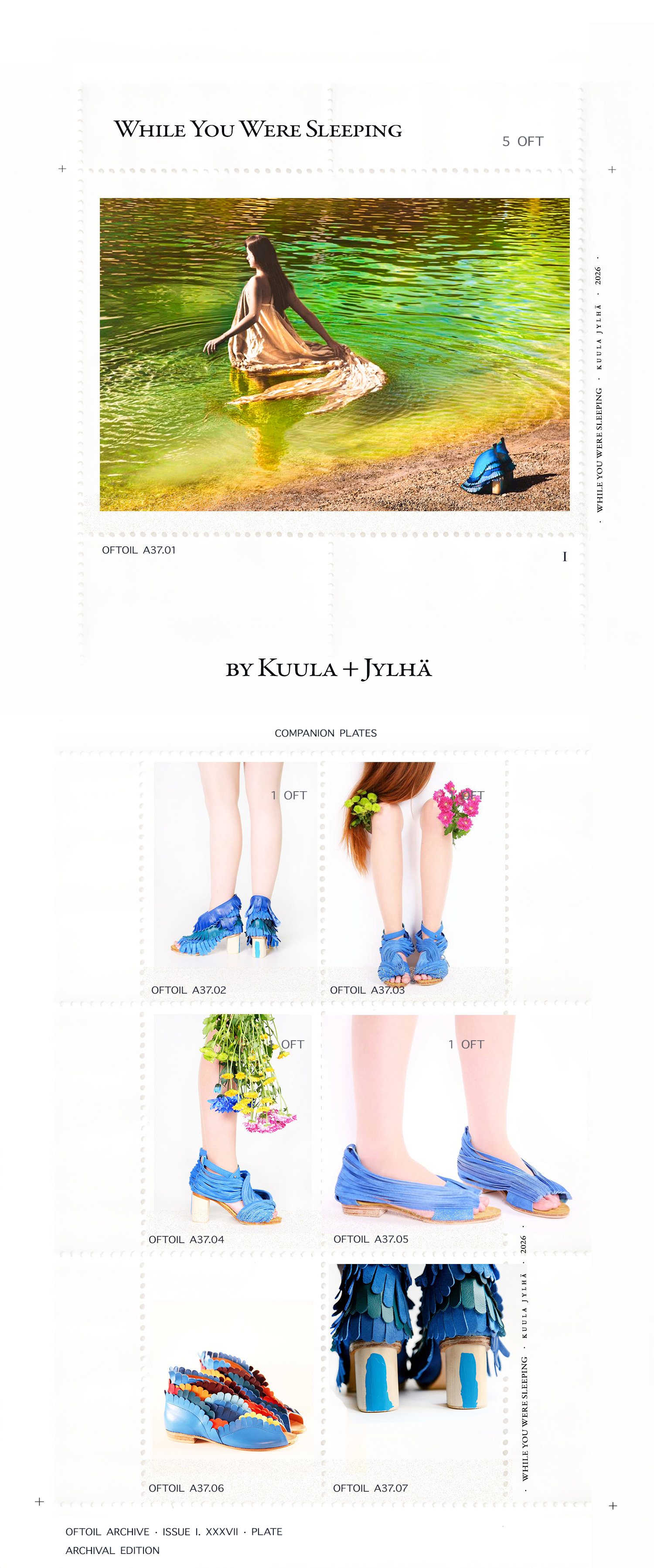
A collection staged between sleep and awakening. Saturated blues, layered scales, and softened forms evoke water, flora, and the half-clarity of dreams recalled at dawn.
The shoes appear almost amphibious—caught between land and lake, ornament and organism. Movement becomes fluid; walking resembles drifting.
The imagery reinforces this suspended state. Flowers, bare skin, and reflective water dissolve the boundary between body and environment, allowing fashion to behave less like costume than atmosphere.

Volume replaces ornament. Wrapped leather spirals around the foot like bandage, shell, or unfolding paper construction, emphasizing gesture over symmetry.
White dominates the series with ceremonial restraint. The forms feel provisional yet deliberate, as though assembled in response to instinct rather than convention.
There is a strange tenderness in the imbalance of the objects: heels carved like fragments of wood, straps crossing unpredictably, silhouettes collapsing and rebuilding themselves with each angle. Fashion here becomes emotional topography.

The collection introduces tension through contrast: vivid orange against black, smooth leather interrupted by coarse horsehair textures. Precision collides with something untamed.
The shoes recall ceremonial costume, folk object, and modernist composition simultaneously. Hair-like surfaces animate the silhouettes, turning still objects into forms charged with latent movement.
What emerges is a study in controlled wildness. Elegance is preserved, but only barely—held at the edge of instinct, rupture, and play.
“Small groups of wild horses were reported through the 1940s and 1950s in an area between the Baitag-Bogdo ridge and the ridge of the Takhin-Shaar Nuruu (which, translated from Mongolian, means ‘the Yellow Mountain of the Wild Horse’), but numbers appeared to decline dramatically after World War II. The last confirmed sighting in the wild was made in 1969 by the Mongolian scientist N. Dovchin. He saw a stallion near a spring called Gun Tamga, north of the Takhin-Shaar Nuruu, in the Dzungarian Gobi (Paklina and Pozdnyakova 1989).
For collection 2014 the designers travelled with the Wild King. From the Ural, through Mongolia and gazed him in the eyes at the spring called Gun Tamga. They have beautifully combined horse hair and vegetable tanned leather from Northern Ostrobotnia and birch from Northern Ostrobotnian forest.
Kuula + Jylhä construct footwear as collectible image-objects: pieces that exist equally within fashion, sculpture, and performance. Their work refuses passive elegance in favor of tactile invention, where material experimentation becomes narrative language. Preserved within the archive, these plates document shoes not simply as products, but as emotional architectures designed to be worn, remembered, and encountered like small surreal monuments.
Words & images courtesy of Designers Essi Kuula & Marika Jylhä


