“We are interested in how design can reveal the political, ecological and cultural forces embedded within the material world.”
— Formafantasma
— Formafantasma
Working between research, craft and industrial production, Formafantasma treats objects as records rather than commodities. Their collections rarely begin with style. Instead, they begin with systems: extraction, energy, ritual, memory and the invisible histories carried by materials themselves.
Whether working with charcoal, moulded ceramics or delicate glass vessels, the studio approaches design as a form of investigation. Each piece becomes an artifact through which forgotten traditions and contemporary realities are brought into conversation. Beauty is never isolated from context; it is allowed to emerge from the stories already contained within matter.
In 2012 in conjunction with a major retrospective on Gerrit Rietveld at the Vitra Design Museum1, the curator, Amelie Znidaric, invited five designers working in the Netherlands to join a partner from the region in developing a design proposal.
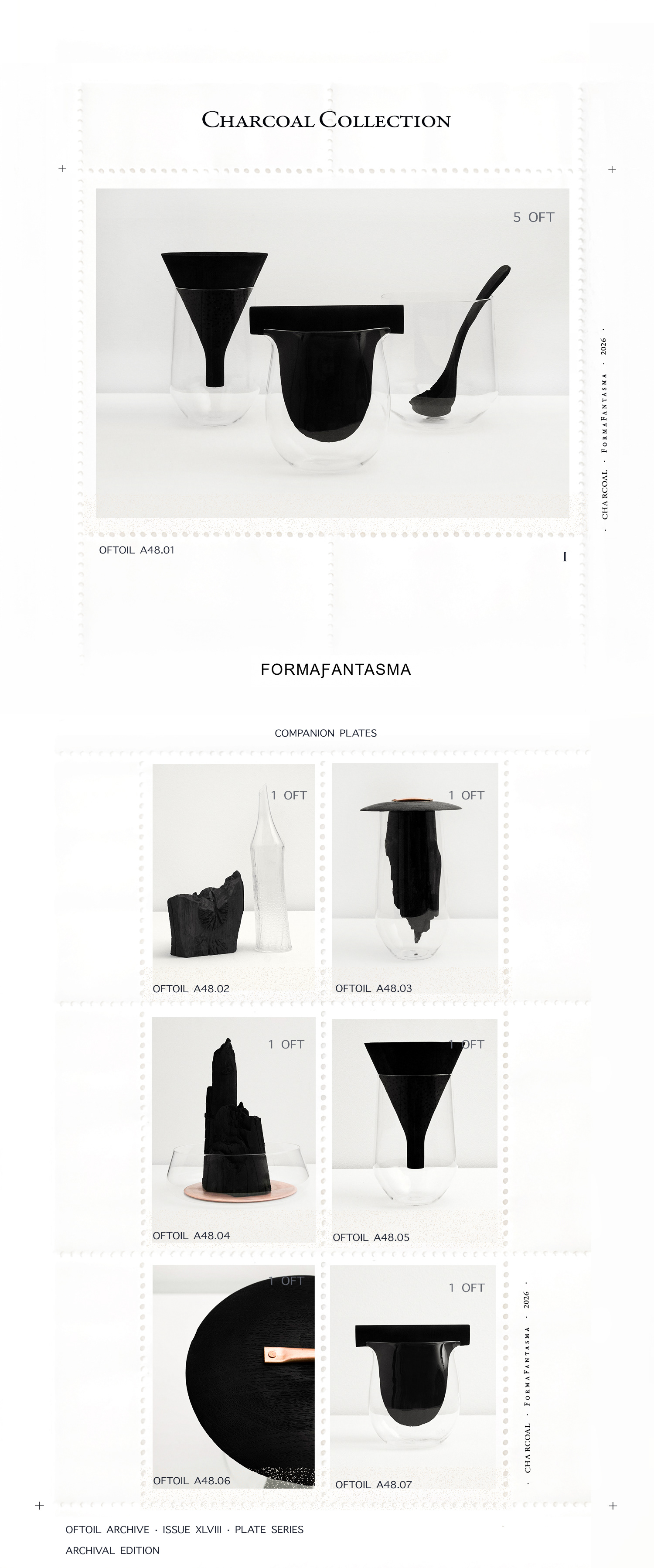
For this project, Formafantasma was paired with Ms Doris Wicki2, one of the last people dedicated to the tradition of producing charcoal by the slow-burning (5 – 7 days) of wood. The activity, deeply rooted in Swiss tradition, was economically important when charcoal was produced as a metallurgical fuel but was banned in the twentieth century due to deforestation and CO2 emissions.Despite the negative connotations, a few charcoal burners are still operating today.
The passing of time has transformed this elaborate production process into a nostalgic ‘happening’, often relegated to festive folk events. In other parts of the world, charcoal burning is still a reality. In the Congo, for example, charcoal burning threatens the Virunga National Park, one of the nation’s most significant nature reserves. Formafantasma drew inspiration from the tension between the dystopian connotation of charcoal, causing pollution and destruction, and its beneficent use in healthcare and water purification.
Historians have found evidence that carbon filtration was used by the ancient Egyptians, while in Japan it is still common today to use a few simple charcoal branches to purify tap water. In collaboration with a glassblower and woodcarver, the designers produced a series of jars and wooden ‘filters’. Over the course of a few days spent with Ms Wicki and photographer Luisa Zanzani in a forest in the surroundings of Zurich, the customized wooden pieces were left burning and deteriorating while the process was documented. The charred remains were further sculpted into a series of elements and added to the glass jars. In addition, a small glass bottle was blown into a hollow carbonized log: the resulting glass becoming opaque and textured where it came into contact with the charcoal, yet maintaining clarity in the rest of the body. Alongside the design pieces, black charcoal bread (baked following a traditional recipe to aid digestion) and purified water were served during the days of the event. Participants were invited to ‘raise their glasses’ to this tradition and experience what this meant in the past: twelve hand – made charcoal drawings made by designer Francesco Zorzi portraying trees burning, polluted cities, fumes and black rain, were on display at the exhibition to highlight the misuse of charcoal throughout the ages.
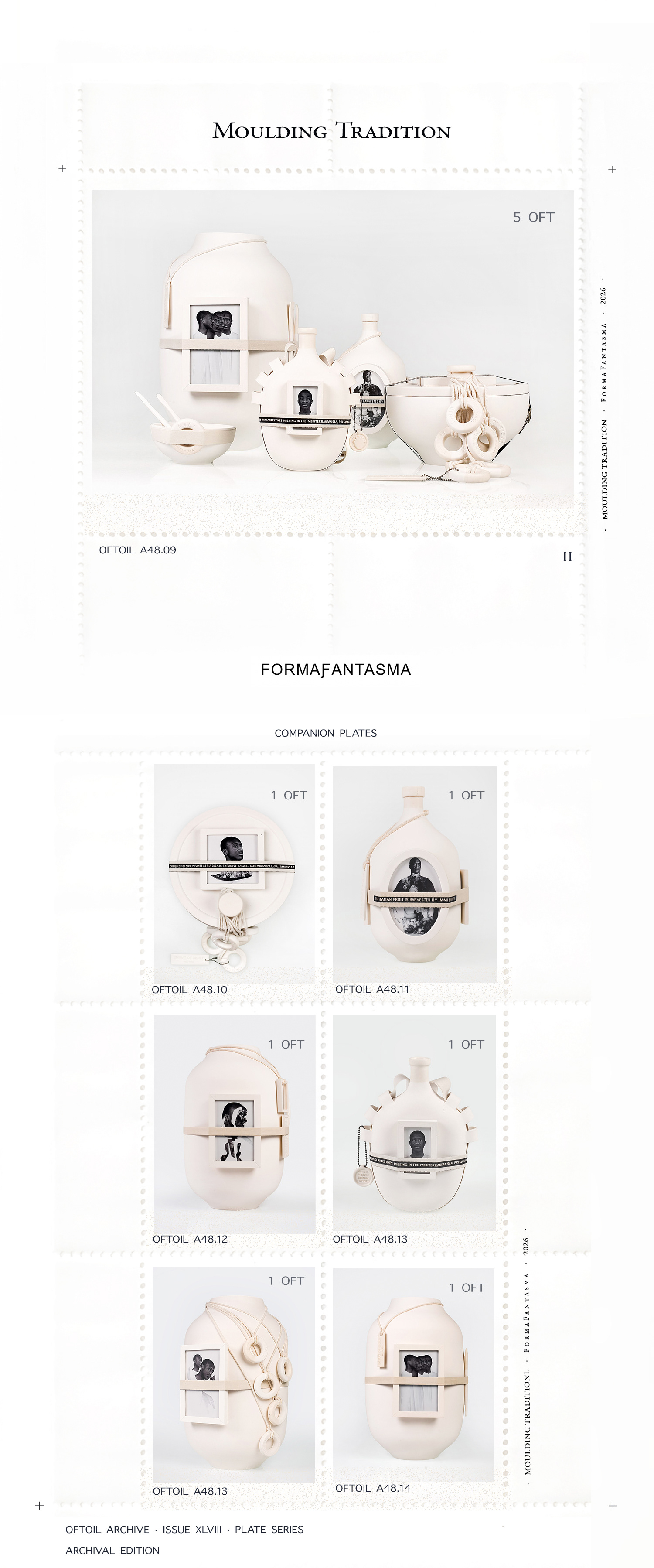
Moulding Tradition centers on the geo – political (and pertinent) issues of immigration, assimilation, and the historical cross – flow of cultural currents between North Africa and Italy.
Moulding Tradition is informed by the ongoing Sicilian ceramic tradition of Teste di Moro: copies of seventeenth – century vases from Caltagirone1 in Sicily that portray a grotesque Moorish face. The tradition refers to an earlier era in Sicily’s history when the Moorish invasion of the area introduced majolica ceramics to Europe.
Over ten centuries later, the same people that once occupied Sicily, bringing their cultural heritage that helped make Caltagirone famous, are returning – not as conquerors but as immigrants. Recent public opinion polls have claimed that 65% of Italians believe that the immigrants are ‘a danger for our culture’. Through Moulding Tradition, Formafantasma documents these contradictions while questioning attitudes towards immigration, national identity and the tendency of craft to perpetuate the past mindlessly.
Each object speaks to some aspect of the immigrant experience – wine bottles recall the fruit in Sicily harvested by migrants and bowls represent the boats conveying refugees across the Mediterranean. The result is a collection of refined ceramic vessels garlanded with portraits of an émigré, buoy – like discs engraved with the percentage of refugees who immigrate per year, and ribbons woven with news reports on illegal immigration published during the project’s production period.
Water covers 70% of the Earth's surface, and it is vital for all known forms of life. Only 2.5% of the Earth's water is freshwater, while less than 0.3% of all freshwater is found in rivers, lakes, and the atmosphere.
'Still' is a collection of carefully engraved crystals, designed to serve the most humble and fundamental of all drinks: tap water. The works have been developed for and in cooperation with the renewed Viennese company J.& L. Lobmeyr1. The collection pairs crystal with copper and activated charcoal to improve the taste of tap water.
As a homage to the great tradition of Lobmeyr, the designers have included in the collection two customized versions of the Candy Dish designed by Oswald Haerdtl for the company in 1925, now to be used as containers for activated charcoal. Formafantasma also designed a copper spoon inspired by the iconic piece and a series of copper cups as a reference to the Drinking service no.267 'Alpha' designed by Hans Herald Rath.
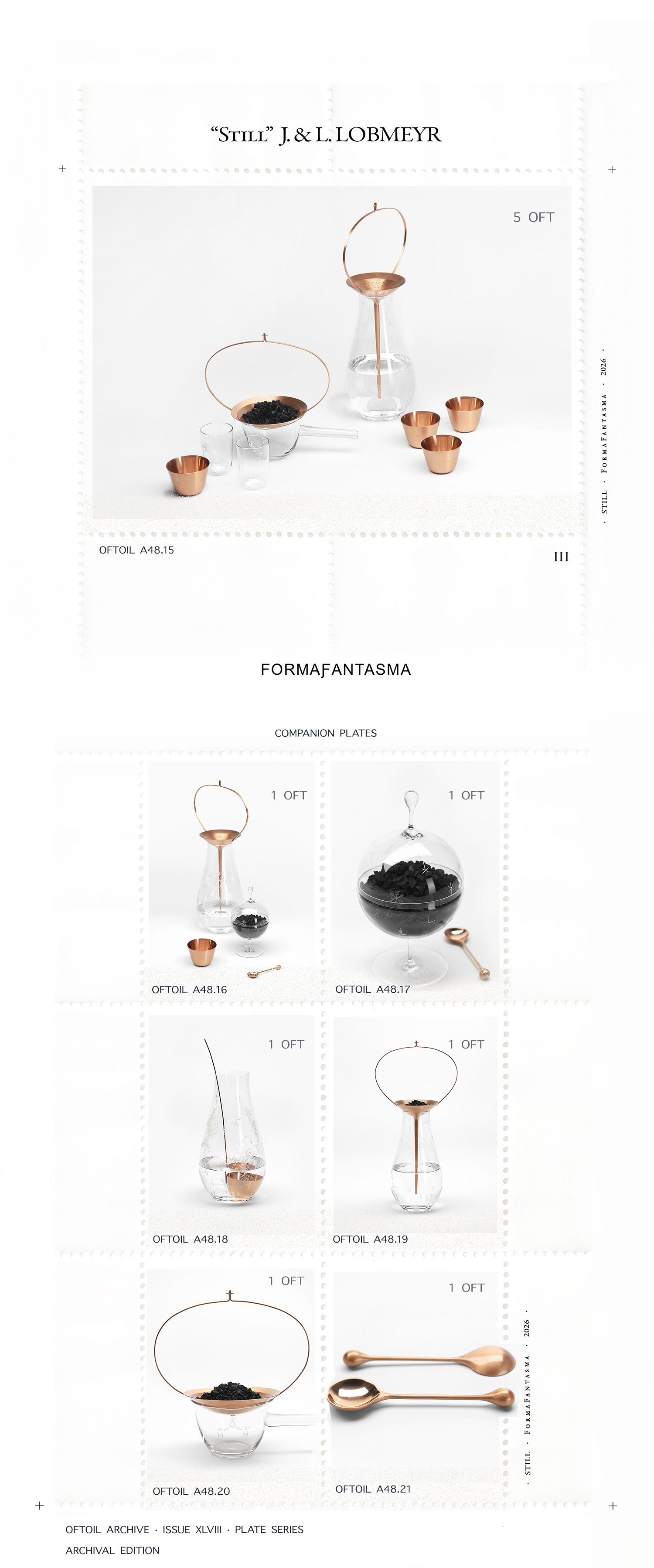
Across these plates, Formafantasma reminds us that objects possess biographies. Charcoal recalls ancient transformations, moulded vessels preserve traces of inherited practices, and copper-framed glassware turns ritual into quiet ceremony. Nothing appears ornamental for its own sake. Every gesture carries evidence of process, history and use.
Collected together, these works read less as products than as specimens from a larger archive—fragments of human knowledge translated into form. They suggest that design’s enduring role is not merely to invent the new, but to uncover what has always been present, waiting to be seen again.
Words & images courtesy of Formafantasma