“The more that is removed, the more clearly the world appears.”
— Lee Ufan
— Lee Ufan
Few artists have altered the language of contemporary art through such restraint. As a founding figure of Mono-ha (School of Things), Lee Ufan rejected the idea that art should dominate matter. Instead, he revealed relationships—between object and space, pigment and canvas, presence and absence, artwork and viewer.
His paintings are not compositions in the traditional sense. Each mark exists as an event: deliberate, finite, and left incomplete. The untouched surface is never empty—it is an active participant. The canvas breathes alongside the brushstroke, allowing silence to become material.
Across these works, repetition does not imply sameness. Every gesture records a different duration, pressure, rhythm, and encounter. They ask little of the viewer except patience, rewarding sustained looking with a heightened awareness of space itself.
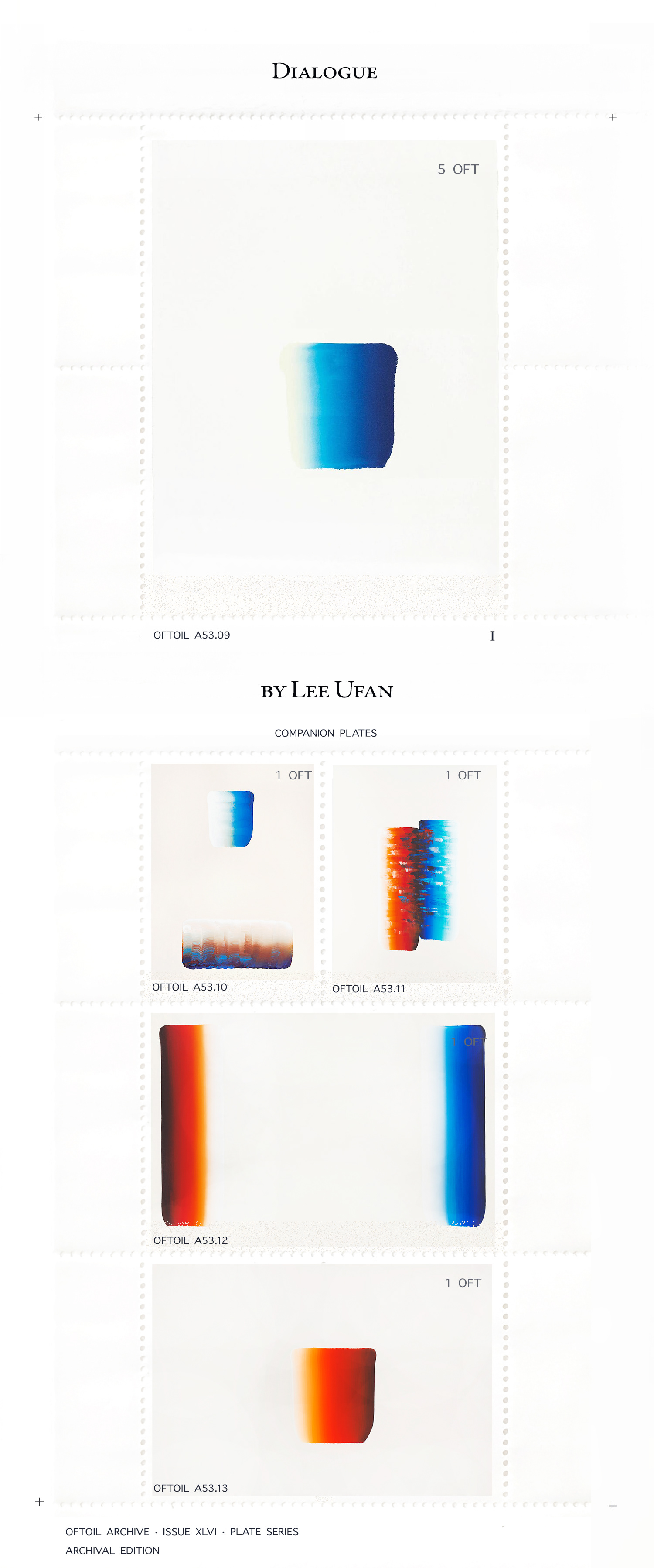
Plate A53.09 —
DialogueA single blue rectangular brushstroke occupies an expansive white field. The surrounding space functions not as background but as an equal participant in the work.
Plate A53.10
Two isolated gestures occupy separate regions of the canvas. Their visual conversation occurs through the space that divides them.
Plate A53.11
Blue and red brushstrokes meet in quiet tension. Neither dominates; each defines the presence of the other.
Plate A53.12
Two vertical bands stand at opposite edges, leaving the center intentionally vacant. The interval itself becomes the subject.
Plate A53.13
A solitary red form rests within an expansive field of white, emphasizing weight, gravity, and stillness through radical simplicity.
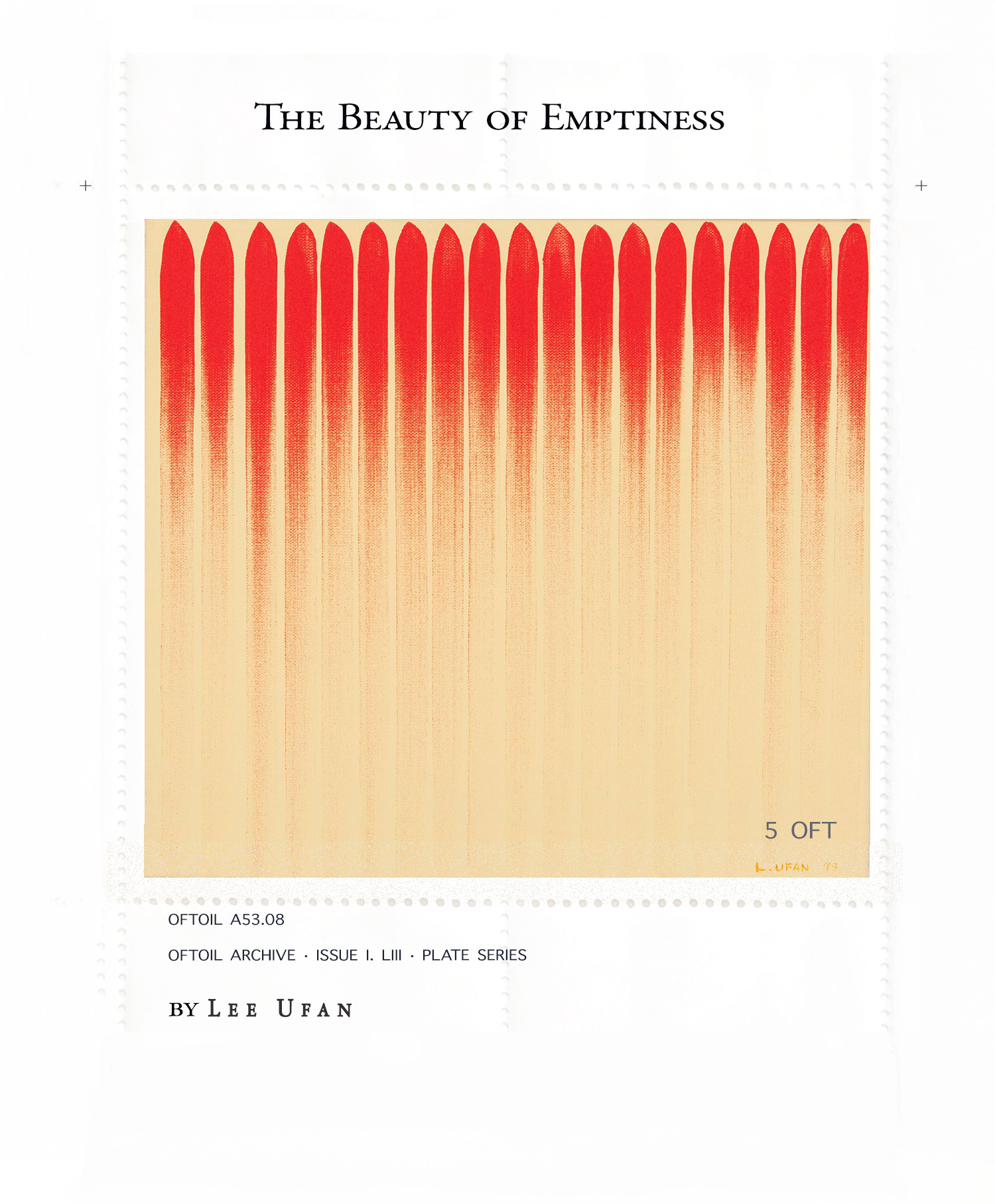
Plate A53.08 —
The Beauty of EmptinessA sequence of vertical red forms fades almost completely into the untouched ground. Presence slowly yields to absence, allowing emptiness to complete the composition.
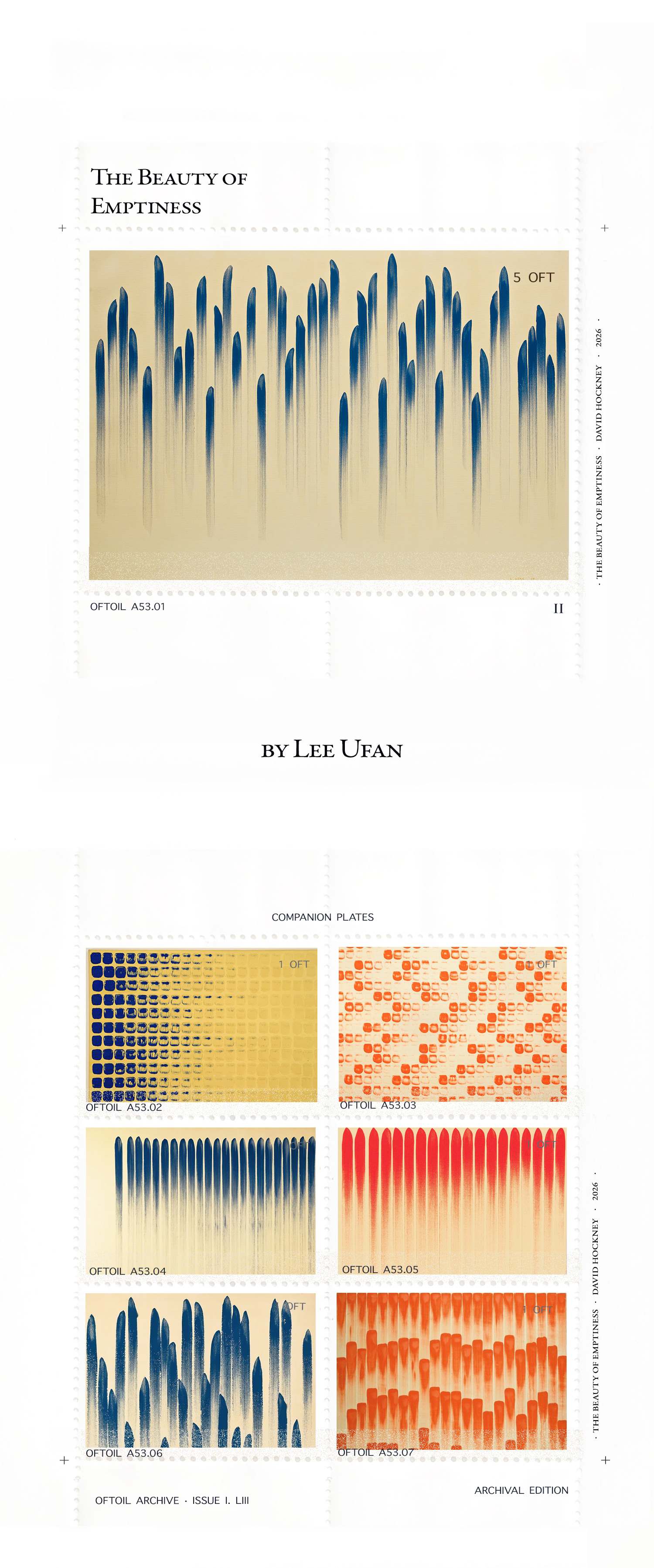
Plate A53.01 —
The Beauty of EmptinessVertical blue forms rise and dissolve before reaching completion. Rhythm replaces representation, creating a field where repetition becomes meditation rather than pattern.
Plate A53.02
Individual impressions accumulate into an ordered grid before gradually fading into untouched canvas. Density gives way to openness.
Plate A53.03
Warm red marks appear as independent events rather than continuous form. Distance between each gesture becomes as significant as the gesture itself.
Plate A53.04
Parallel blue strokes descend with measured consistency, each ending in gradual disappearance. Time becomes visible through repetition.
Plate A53.05
Rows of crimson marks dissolve downward into silence. The image appears to evaporate rather than conclude.
Plate A53.06
Columns of varying height create an irregular skyline suspended between order and chance. Structure emerges without rigid geometry.
Plate A53.07
Orange forms gather into shifting clusters whose intervals generate movement across the surface. The painting balances accumulation with restraint.
Lee Ufan’s paintings are often described as minimal, yet their ambition is expansive. Rather than filling space with images, they cultivate awareness of everything that already exists—light, distance, breath, and time. They remind us that absence is not a lack of meaning but one of its purest forms.
Within the ofToil Archive, these works become records of perception itself: enduring examples of how the smallest gesture can transform an entire field of vision.
Words & images courtesy of Lee Ufan