
"I find [light] interesting because it's an immaterial substance. This idea of working with something that's about effect; it's intangible, you're really shaping form to maximise a lighting effect."
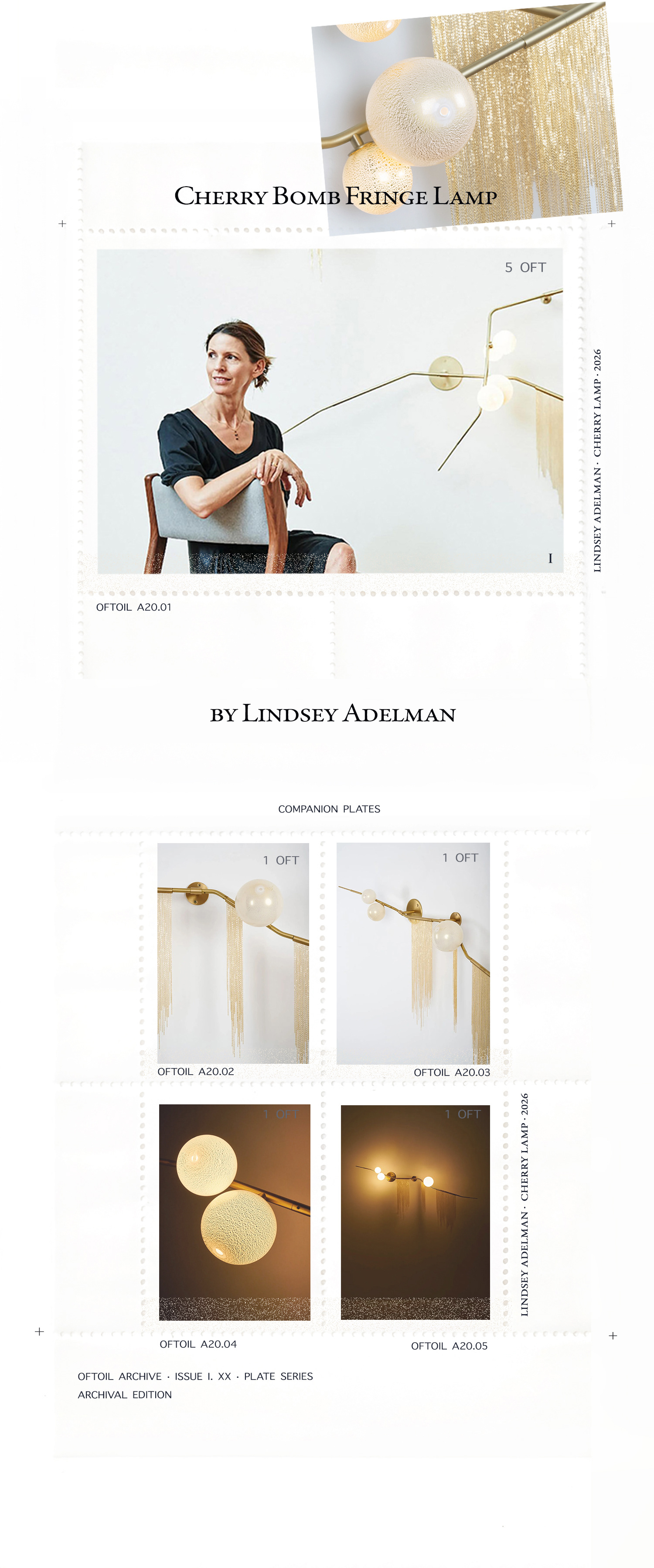
Cherry Bomb Fringe
Light extends beyond its source.
Glass orbs anchor the structure, while fine metallic fringes descend in quiet motion, catching and diffusing illumination. The fixture is not contained—it radiates, softening its own boundaries.
Form becomes atmosphere.
Structure loosens into gesture.
Arms branch, lines bend, and elements suspend in delicate imbalance. What appears engineered reveals a latent fluidity.
Cherry Bomb
Clusters articulate space.
Glass volumes gather around a central axis, balancing weight and transparency. Each node emits and reflects, creating a constellation where light is both source and surface.
The object holds, yet never closes.

Repetition becomes rhythm.
Elements recur with slight variation, allowing the system to expand without losing coherence. The eye follows connection rather than form.
Totem Lamp
Verticality becomes sequence.
Stacked components—glass, metal, void—align into a suspended column. Each segment differs, yet belongs to a continuous order, where balance is maintained through contrast.
Light moves through the structure.
It is not fixed within it.

The work of Lindsey Adelman operates at the intersection of structure and effect.
Her lighting does not begin with illumination alone, but with the conditions that allow light to disperse, reflect, and transform. Form is not an end—it is a means of shaping something inherently immaterial.
In the Cherry Bomb series, this condition is articulated through clustering.
Glass spheres gather along branching metal frameworks, forming constellations that resist singular focus. Each element acts simultaneously as container and reflector, producing a layered field of light. The object is stable, yet visually expansive—its boundaries defined not by structure, but by diffusion.
Cherry Bomb Fringe extends this logic outward.
Fine metallic strands introduce movement and softness, capturing light beyond the central form. The fixture dissolves into its surroundings, shifting from object to atmosphere. What is designed is no longer only the lamp, but the space it inhabits.
With Totem, the system condenses.
Vertical alignment replaces branching, organizing elements into a sequential column. Variation is retained, but contained within a linear order. The result is a different kind of balance—less expansive, more concentrated—where light travels through the structure rather than radiating from it.
Across these works, material serves the immaterial.
Glass, metal, and void are arranged not for their own presence, but for their capacity to mediate light. The visible object becomes secondary to the effect it produces.
In this sense, the work does not present light.
It constructs the conditions in which light can be perceived.


