
“My work is about how we perceive and relate to the landscape.”
- Maya Lin
The first generative art project by artist, architect, and environmental activist Maya Lin—centers on the organic growth patterns of a living, subterranean network of tree roots. The project takes its title from Lin’s acclaimed 2021 installation Ghost Forest, for which she brought 50 towering Atlantic white cedar trees to New York’s Madison Square Park as part of an examination of the Earth’s vulnerability and the impact of the climate crisis. As such, Ghost Forest Seedlings reflects the artist’s deep sensitivity to the complexity, beauty, and fragility of the natural world and its interconnected systems.
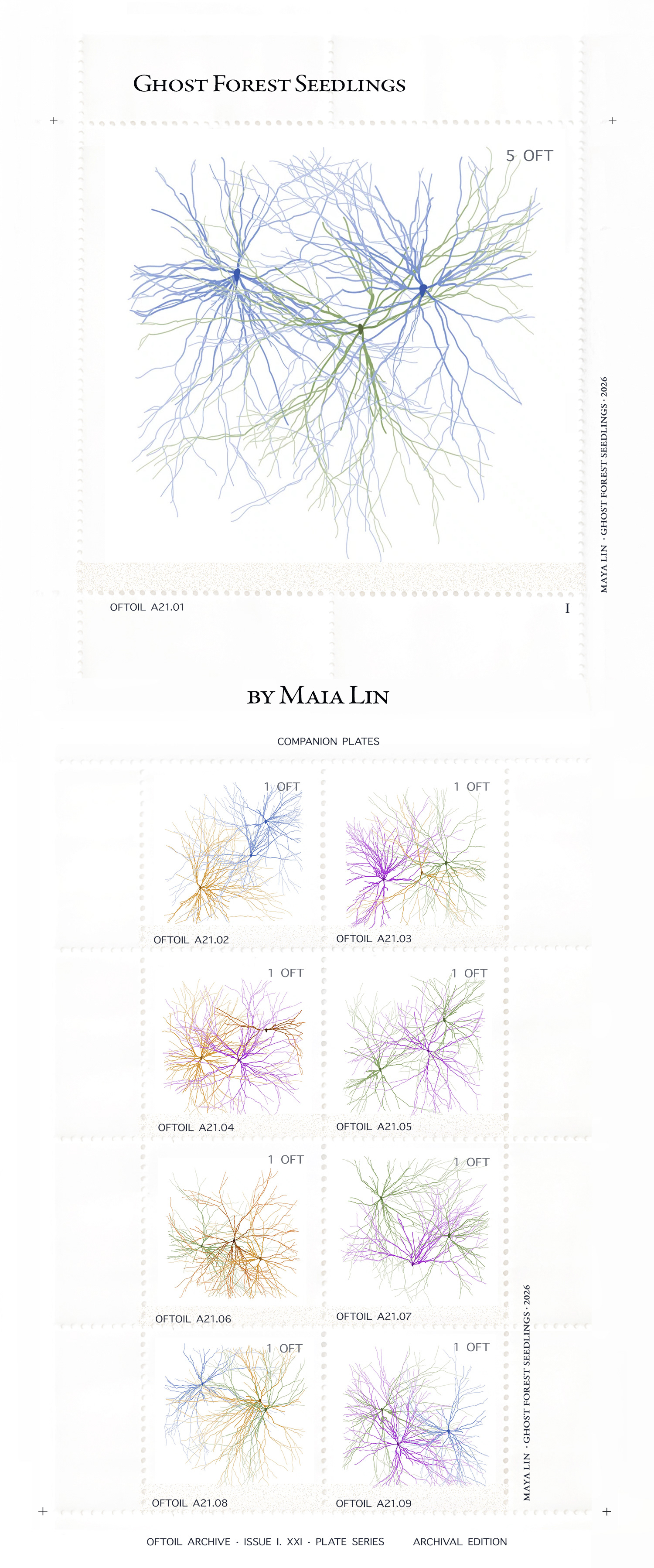
Ghost Forest Seedlings artworks depict a seed or group of seeds that grows into an intricate root pattern, or seedling, over a predetermined amount of time.
Priced at $1,000, each of the 500 unique works from the project will include three components: a signed print of the final root system on Hahnemühle Bamboo paper; a generative NFT that shows the seedling’s evolution in real-time; and a video timelapse tracing the seedling’s complete growth pattern.
The algorithm that Lin has developed for this project will generate growth patterns as expansive and intricate as those found in nature, and varying traits in the Ghost Forest Seedlings artworks include the number of seeds in each work; the colors of each seed and root; the number of roots that grow; and the duration of the growth period for the root systems, which can range from one hour to three months.
Seasons
Lin’s Ghost Forest Seedlings are expressed in a range of phantasmagoric colors that can be understood in relation to the seasons. Here, the Pace Verso team presents a selection of artworks in four sub-categories: winter, spring, summer, and fall. While the colors in the “summer” prints are electric and vivid, the “fall” artworks lean into the rich, warm oranges, browns, and greens of the changing season. Calming blue tones cut across the “winter” root systems, and, in the “spring” prints, vibrant purples and greens mingle with browns and blues. Rendered in these seasonal hues, Lin’s sinuous, complex root systems speak to her longstanding artistic investigations of synergistic phenomena in the natural world.
Sensibility
Lin’s linear Ghost Forest Seedlings compositions lean into different aesthetic territories, with some skewing maximalist and others more minimalist. Here, the artworks have been organized within those two categories. The maximalist compositions feature mesmeric entanglements of roots, often rendered in more than one color. The minimalist ones, meanwhile, possess a quiet poetry, depicting the growth patterns of singular seeds. Together, these maximalist- and minimalist-minded compositions speak to the simultaneous complexity and simplicity of the systems that make up the natural world.

“How can we protect it if we don’t even know when it’s gone?”
In Disappearing Bodies of Water, Lin reduces geography to its most fragile trace. Rivers, lakes, and watersheds are rendered as faint, almost vanishing lines—cartographies on the verge of erasure. What remains is not presence, but absence articulated.
These works resist spectacle. Their scale is intimate, their materiality restrained, their visual language nearly silent. Yet within this restraint lies their force: the realization that entire systems—vast, life-sustaining, historically permanent—can recede into invisibility.
The drawings operate as both record and warning, but never declare themselves as such.
Lin’s method is consistent: she does not illustrate loss, she allows it to appear. The viewer is left to confront the instability of what once seemed fixed. In this space between recognition and disappearance, the work becomes a quiet threshold—between memory and oblivion, knowledge and neglect.
"I don’t think of myself as a message-based artist. I think of myself as someone who is creating a place for people to think.”
— Maya Lin
From the outset of her practice, Maya Lin has worked with a language of reduction—form pared down to its most essential articulation, yet carrying within it the weight of vast systems. Flow extends this vocabulary into the realm of water: not as image, but as structure, memory, and consequence.
The works unfold as quiet topographies. Carved, cast, or assembled, they trace the invisible architectures that govern the natural world—watersheds, glacial movements, submerged histories.
images and words courtesy of Pace Gallery and Maya Lin Studio
+ Maya Lin Studio
Materials are never neutral; silver, encaustic, and wood are chosen not only for their physical qualities, but for their capacity to echo transformation—melting, erosion, accumulation. In this, the work does not depict change; it embodies it.
What emerges is not instruction, but awareness. Familiar geographies dissolve into abstraction, scale expands beyond recognition, and the viewer is repositioned—no longer above the landscape, but within its systems. Flow does not argue; it reveals. The work allows the viewer to encounter the quiet magnitude of what is often unseen, and to recognize that natural forces persist, indifferent to the boundaries we impose.


