
“I wanted the building to be simple, almost pure—like an egg. A form that contains everything, yet reveals nothing at once.”
— Paul Andreu
Set within water, the National Centre for the Performing Arts—often called the “Giant Egg”—emerges as a singular, self-contained volume: an ellipsoid of titanium and glass, hovering at the edge of monument and mirage. Conceived by Paul Andreu, the structure withdraws from the immediate language of the city, choosing instead a geometry that precedes ornament, symbol, and narrative.
Approached through a submerged passage, the building resists frontal encounter. It is not entered directly, but arrived at—as though crossing a threshold between conditions rather than spaces. Light refracts across its curved surface; reflections dissolve its mass. What appears solid begins to waver, its presence contingent on atmosphere, time of day, and the quiet movement of water that surrounds it.
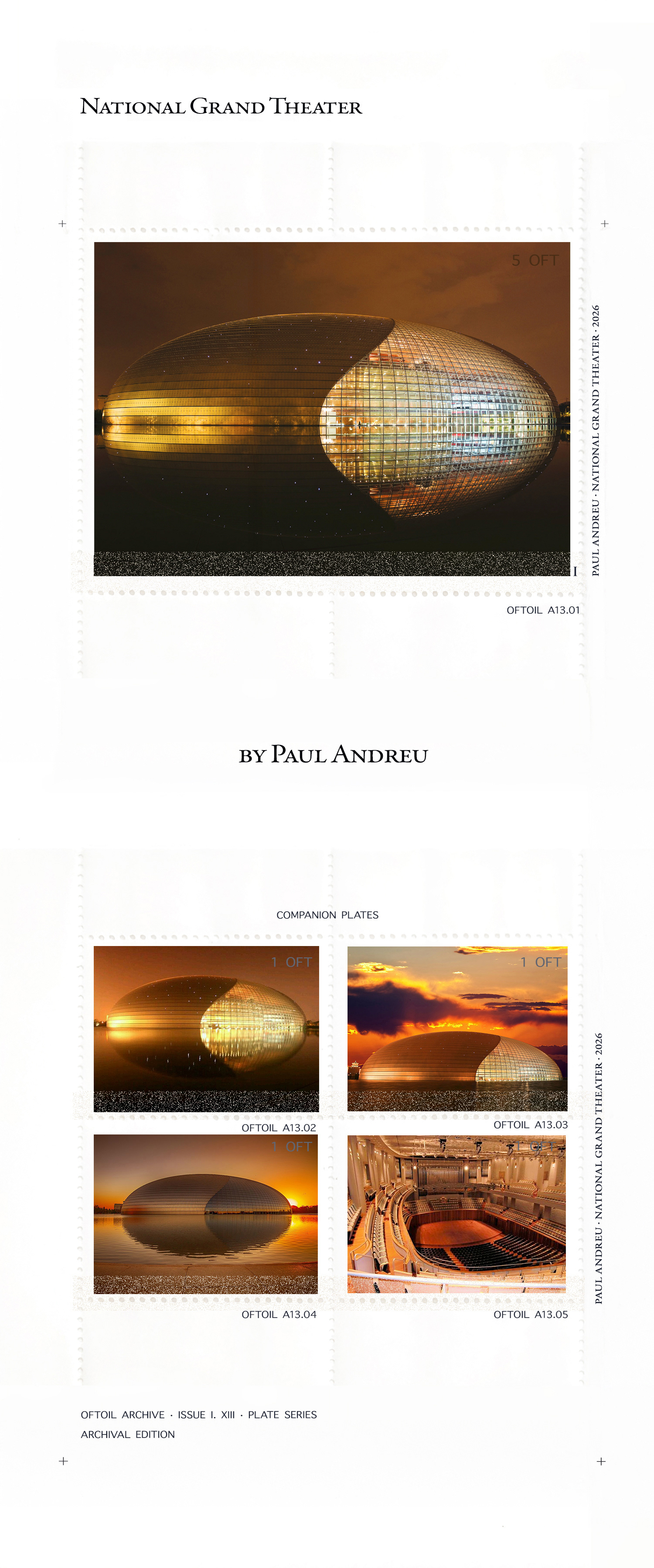

Completed in 2007, the National Centre for the Performing Arts stands in deliberate contrast to its immediate context near Tiananmen Square—a field historically defined by axial clarity and political symbolism. Andreu’s response was neither mimicry nor opposition, but withdrawal into a primary form: the ellipsoid. Constructed from over 18,000 titanium panels and more than 1,000 sheets of ultra-clear glass, the envelope operates as both skin and horizon—reflective, continuous, and without hierarchy. The building does not present façades; it offers a condition of enclosure.
Within, the structure unfolds into three principal venues—opera house, concert hall, and theatre—each acoustically and spatially distinct, yet held within the singular volume of the shell. Circulation is fluid, almost subterranean in its logic, reinforcing the sensation that one has entered beneath the surface rather than into a conventional interior. The experience is less architectural promenade than gradual immersion: a sequence of compressions and releases, light wells and voids, calibrated to detach the visitor from the exterior city.
For Paul Andreu, whose career encompassed major infrastructural works—including airports defined by movement and transit—this project marks a shift toward stillness. The “Giant Egg” contains performance, yet it is not expressive in the theatrical sense. Its power resides in restraint: a refusal of overt symbolism in favor of archetype. The form is immediately legible, yet resistant to interpretation—simultaneously futuristic and primordial.
Over time, the building has settled into the cultural fabric of Beijing not as an anomaly, but as a quiet counterpoint. Its reflective surface absorbs the city while remaining apart from it, holding within its volume a different tempo—one governed less by spectacle than by continuity. In this sense, the architecture does not declare itself; it persists. A closed form, infinitely receptive.
Cover Image courtesy of Connie Zhou.
All images copyright of their respective owners.


