
“Emptiness is not nothing. It is a space where something can be placed.”
Elementary forms return to their origin.
Grains, strands, and fragments—rice, wheat, pasta—are reduced to quiet arrangements that reveal both fragility and abundance. Suspended between nourishment and uncertainty, the images register a subtle tension: the simplicity of food, and the systems that sustain it.
They do not illustrate consumption.
They contemplate dependence.
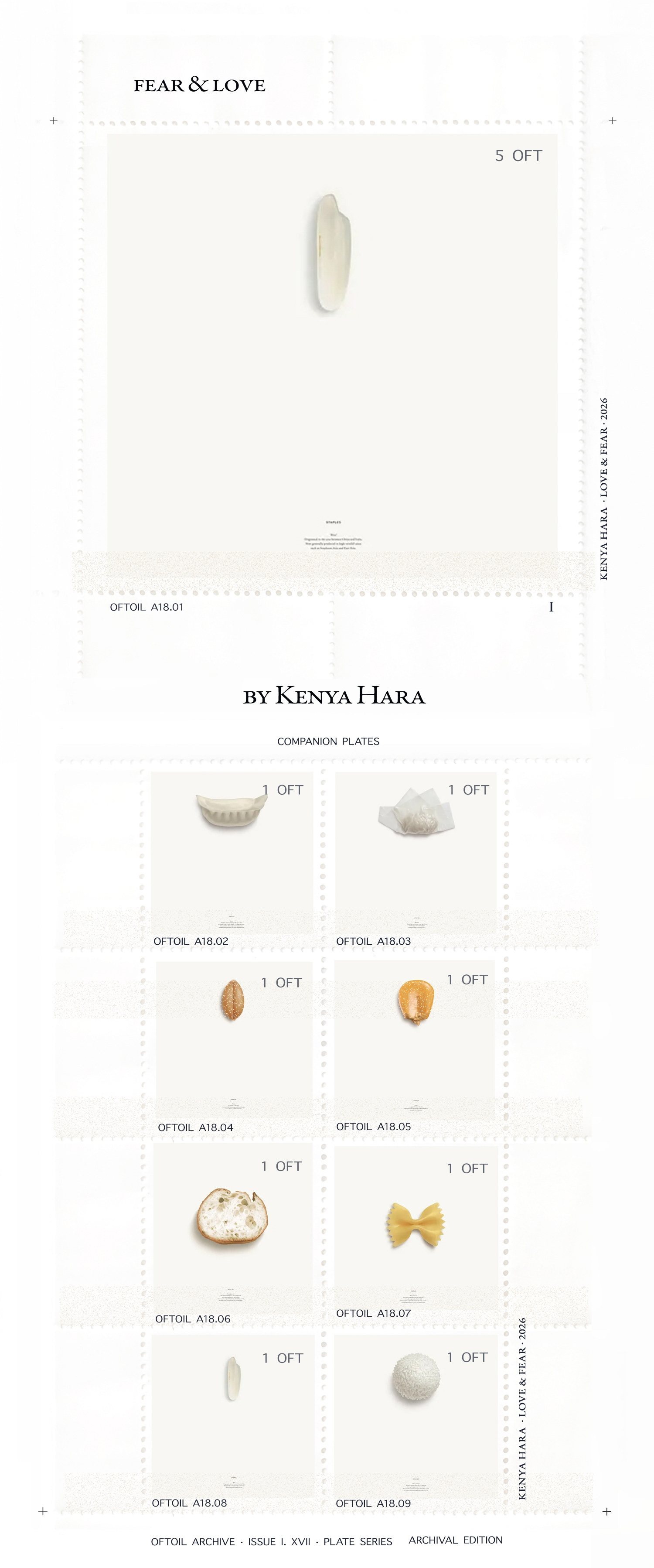
Repetition becomes structure.
Units accumulate—grain by grain, strand by strand—until quantity dissolves into pattern. What begins as matter becomes field, shifting perception from object to continuum.
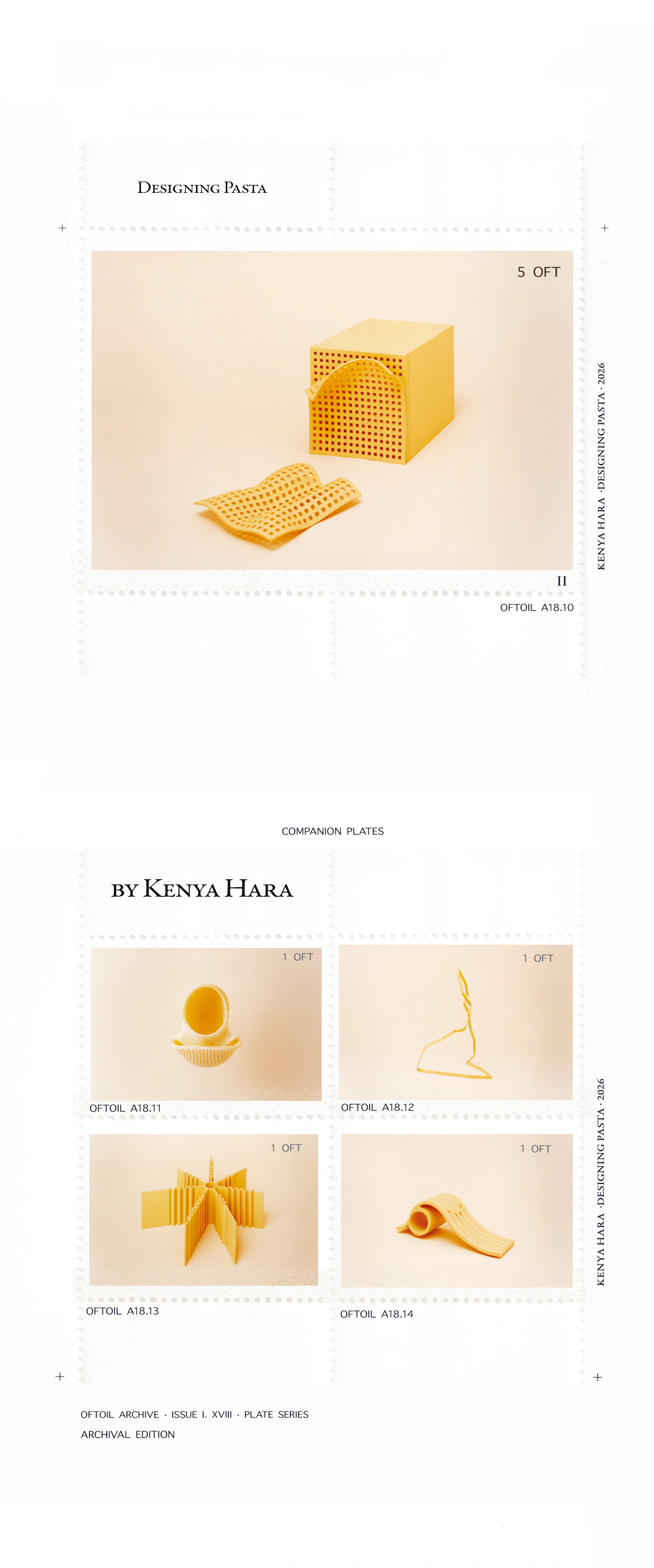
Matter unfolds through variation.
Pasta—extruded, cut, shaped—extends into a taxonomy of form. Each variation is minimal, yet distinct, revealing how difference emerges from constraint.
Form is not invented.
It is discovered through repetition.

The work of Kenya Hara proceeds through reduction.
Across disciplines—graphic design, exhibition, material study—his approach returns objects to a state prior to assumption. This is not minimalism as style, but as method: a deliberate clearing that allows form, matter, and perception to reappear with precision.
In Fear and Love, food is displaced from its context of consumption. Rice, wheat, and pasta are arranged not as sustenance, but as elements—units that accumulate into fields of quiet tension. The work reveals a dual condition: nourishment as both abundance and vulnerability. What appears simple becomes contingent, dependent on systems beyond the frame.
Re-Design extends this logic to the everyday object. By removing familiarity, the object is no longer understood through use, but through presence. The repeated square of toilet paper rolls—aligned, multiplied—transforms utility into structure. Design is not added; it is uncovered through subtraction.
The pasta studies return to material itself.
Variation emerges through constraint: extrusion, pressure, cut. Each form differs slightly, yet belongs to a shared logic. The result is a field of near-identical elements that resist uniformity. Difference is not imposed, but allowed to surface through process.
Across these works, emptiness is not absence, but condition.
It creates the space in which perception becomes active. Objects are no longer consumed visually—they are encountered. Meaning is not declared, but made available.
In this sense, Hara’s work does not seek to communicate.
It seeks to prepare.


