“The desert remembers what people forget. Art merely gives memory a temporary form.”
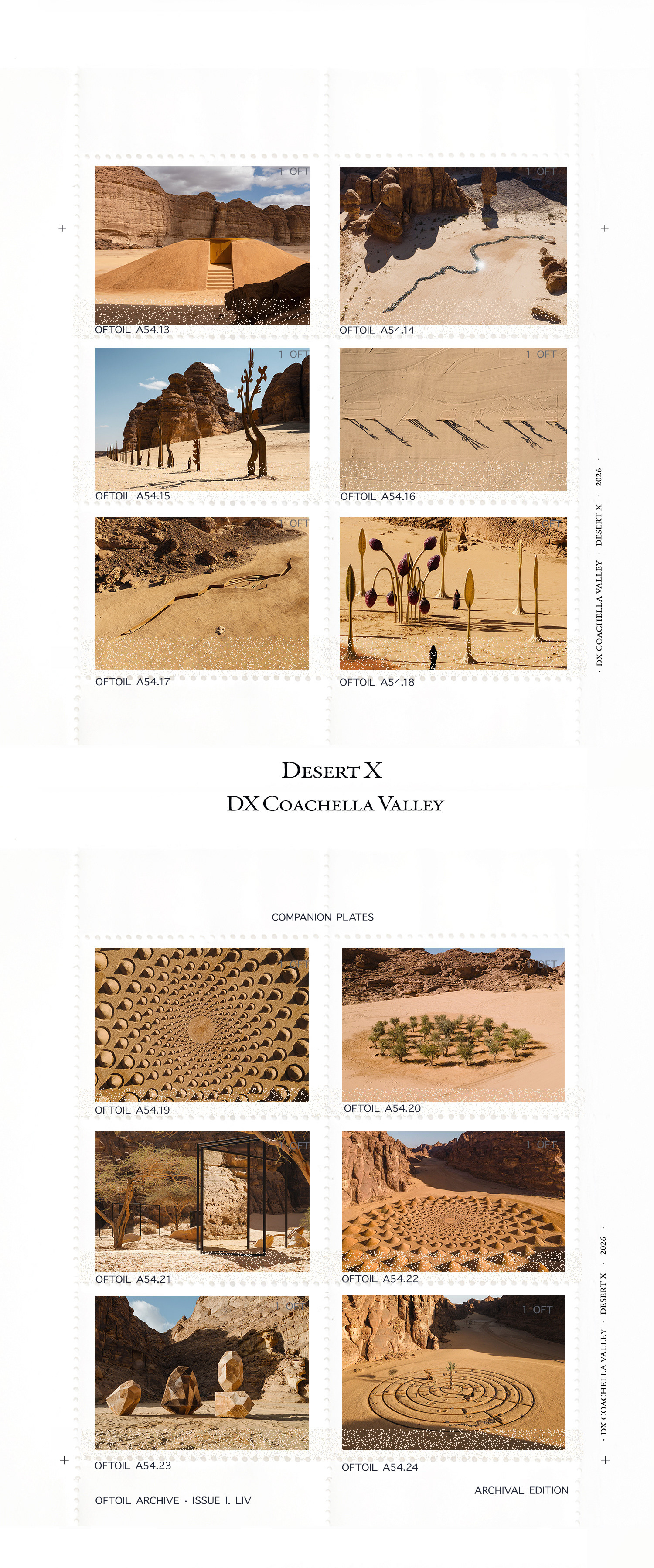
Since 2017, Desert X has transformed the desert into an open-air museum without walls. Spread across the Coachella Valley and beyond, artists respond directly to geology, climate, politics, ecology, and the vast psychological space of the landscape itself. Nothing is permanent. Works emerge, weather, disappear, and survive only through documentation.
Rather than occupying the desert, Desert X enters into dialogue with it. Scale becomes relative. Human intervention feels provisional against formations millions of years old, while mirrors, structures, inscriptions, and interventions reveal the landscape as an active collaborator rather than a passive backdrop.
This Issue gathers several works that exemplify Desert X’s ongoing exploration of perception, place, and impermanence. Collected together, they become not a survey of an exhibition, but a record of a conversation between contemporary art and one of Earth’s oldest environments.
The Geography of Hope
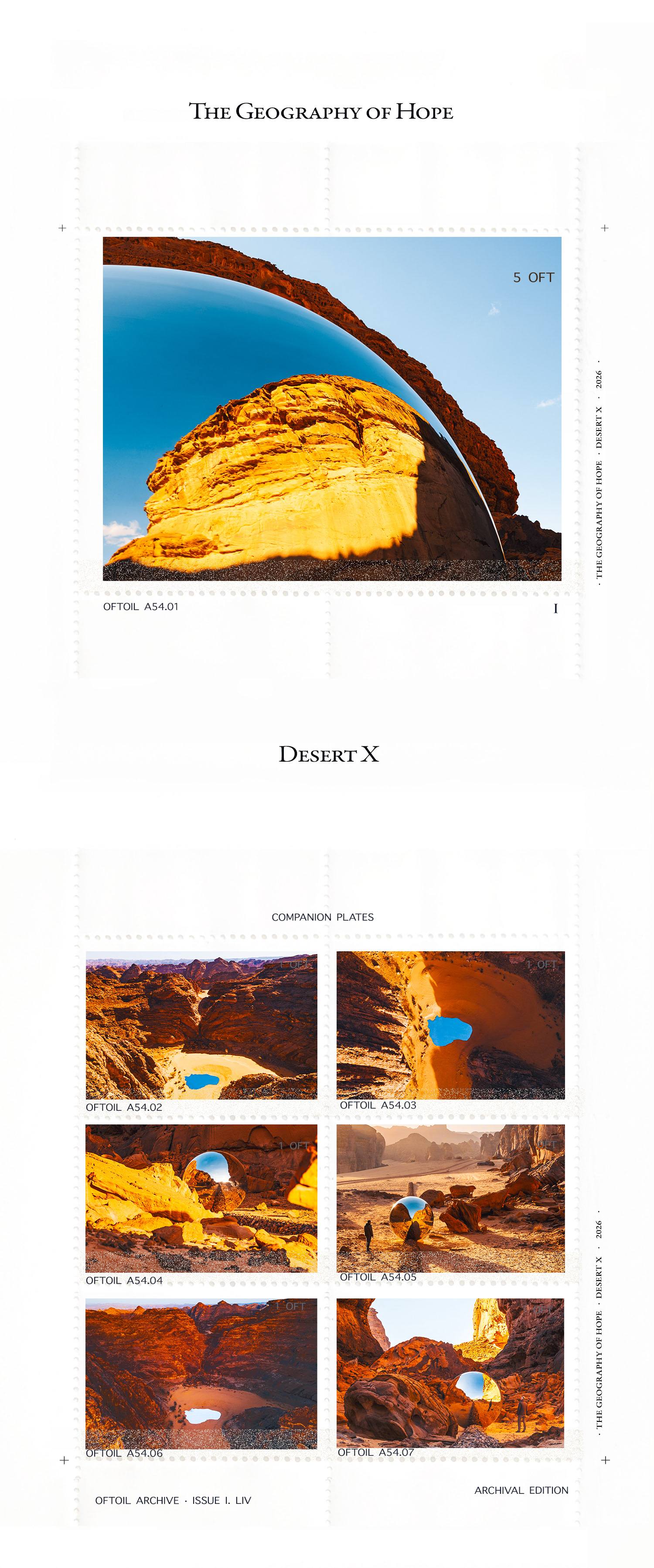
Every scientific theory contains an element of poetry — the poetic refraction of light is summed up in the “phenomenon of mirage.” The mirage has brought hope to the souls of desert inhabitants, taught them patience, and gave them the luxury of dreaming; imagining water so that they could propel each step, providing the determination to reach their destination. The desert mirage was a long-lived inspiration, saving the desert people from death, carrying them from fatigue and despair, and giving them the ability to continue onward. Even after they knew that it was an unreachable mirage, it remained in their souls as a cause for hope and deliverance.
This work seeks to manifest the experience of reaching out to the mirage and capturing it for the first time. The intangible reality of the mirage and its history in desert heritage and Islamic culture serve as the artist’s inspiration to transmute dreams into reality in the AlUla desert. The visual composition of the work is taken from the most prominent mountains in Saudi Arabia and their stories. Using stainless steel, the material interacts with the refraction of light and produces a mirage to create a radiant space.
Abdullah AlOthman (b. 1985, Saudi Arabia, based in Riyadh) is an artist and published contemporary poet born in Riyadh. He believes that the purpose of art goes beyond illustrating issues or applying wisdom. As such, he begins his work at marginal areas and treats them as the center at which his pieces come together. He works in different artistic styles and media, including poetry, video, graffiti, street art and interventions, and installations. The artist’s solo shows include The Question/More Questions, Aloan Artspace, Riyadh (2014). He has exhibited in group shows internationally, including in India, the United States, and most recently at the Diriyah Contemporary Art Biennale.
Geography of Hope
26.651056, 37.992889
AlUla, Saudi Arabia
Desert X AlUla 2022
26.651056, 37.992889
AlUla, Saudi Arabia
Desert X AlUla 2022
The Dot
“The present moment is born and then dies, and then born again, thus creating an endless cycle. As long as mankind exists in the physical world and beyond, if we are awake and conscious of that which is the beyond, then we are in an ‘Immortal Moment.’ However, if we capture any of those moments with an act or a gesture that leaves a trace, then that trace will certify that instant, which becomes an ‘Immortal Moment.’ This is the essence of all our acts that leave traces in the physical world, including artistic creation.”
Samra Faisal takes the “Immortal Moment” as his inspiration; each dot we draw is documentation of this moment in time. The line that our eye perceives in the physical world is nothing but an illusion: looking closely, a line is just an infinite number of very close dots.
Samra Faisal takes the “Immortal Moment” as his inspiration; each dot we draw is documentation of this moment in time. The line that our eye perceives in the physical world is nothing but an illusion: looking closely, a line is just an infinite number of very close dots.
These dots create a trajectory that visually translates into a range. The dots are thus the essence of the image – the image of all existence.
According to RCU geologist Jan Freedman, the small valley where Samra’s artwork will be located was initially formed by a crack in a rock where water and air infiltrated inside and started carving, using the sand grain as a tool. In time, the rift widened and rockslides took place until this crack became the current small valley. This process can, after thousands of years, turn the rocks into desert sand. As a result, Samra sees the “Grain” of sand as an element of formation and destruction, the physical equivalent of The Dot, and his work represents the many moments, mysteries, and traces in the sand and stone of AlUla desert.
Jackrabbit, Cottontail & Spirits of the Desert
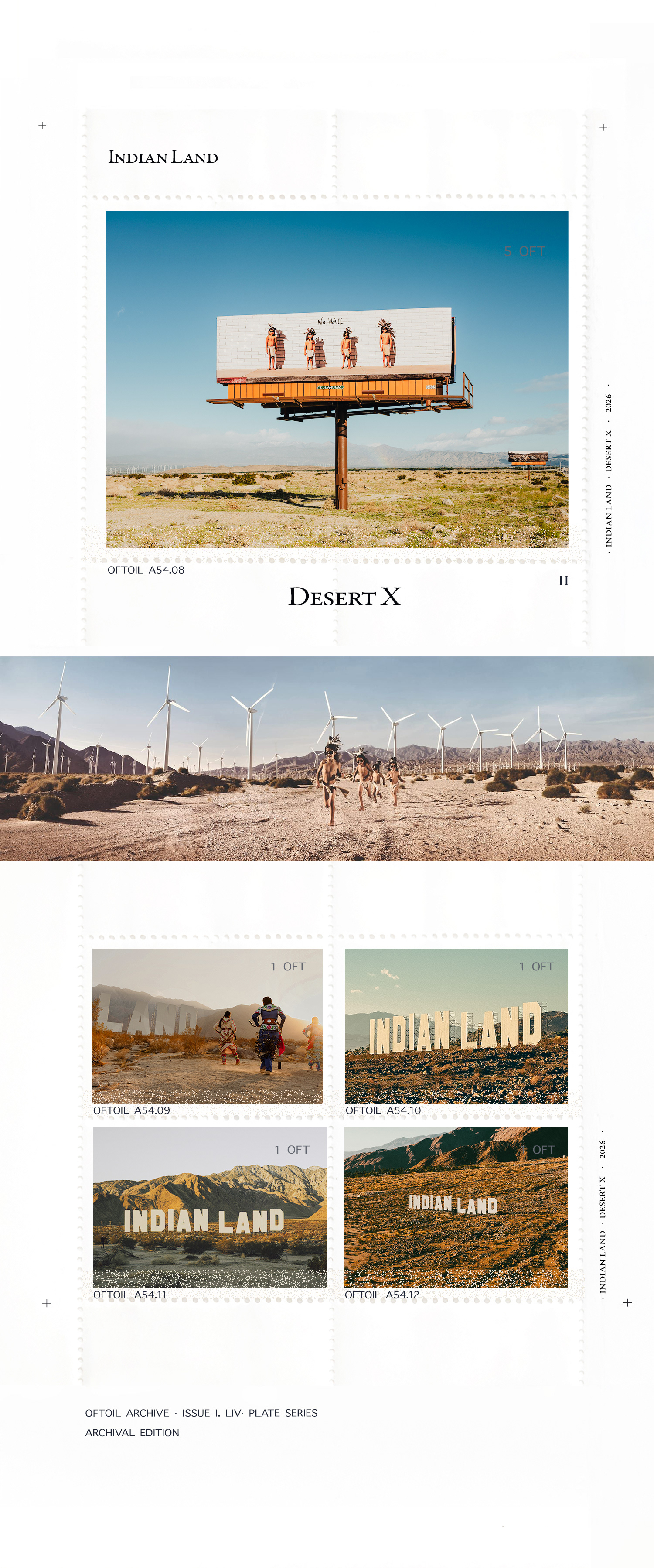
Cara Romero’s new photo-graphic series, Jackrabbit, Cottontail & Spirits of the Desert, responds to the ancestral lands of the Cahuilla, Chemehuevi, Serrano, and Mojave people. These images feature four special time-traveling visitors from Chemehuevi who have come to the ancestral lands of their sister tribes in the Coachella Valley. In Romero’s vision, these small but mighty figures have returned to remind us of our deep connections to the land, the stories contained within it, and how we can live in relation to it. In terms of geological and ancient social history, Palm Springs is a new city located in the ancestral lands of the Cahuillas with a rich history that predates colonization. The images in Jackrabbit, Cottontail & Spirits of the Desert are manifestations of a oral tradition, bringing visibility to the individuals, cultures, and history that continue to inform this landscape, whether or not they have been privileged in the long arc of our collective story.
Jackrabbit, Cottontail & Spirits of the Desert
33.853965, -116.506052
Palm Springs, California, USA
Desert X 2019
33.853965, -116.506052
Palm Springs, California, USA
Desert X 2019
Indian Land
For Nicholas Galanin, a Tlingit and Unangax̂ artist and musician, memory and land are inevitably entwined. The 45-foot letters of Never Forget reference the Hollywood sign, which initially spelled out HOLLYWOODLAND and was erected to promote a whites-only development. Its timing coincided with a development in Palm Springs that also connected to the film industry: Studio contracts limited actors’ travel, contributing to the city’s rise as playground and refuge of the stars. Meanwhile, the white settler mythology of America as the land of the free, home of the brave was promoted in the West, and the landscape was cinematized through the same lens. Never Forget asks settler landowners to participate in the work by transferring land titles and management to local Indigenous communities. The work is a call to action and a reminder that land acknowledgments become only performative when they do not explicitly support the land back movement. Not only does the work transmit a shockwave of historical correction, but also promises to do so globally through social media.
Nicholas Galanin (Sitka, Alaska, 1979) offers a perspective rooted in his connection to the land and intentionally broad engagement with contemporary culture. For more than a decade, he has been embedding incisive observation into his work, investigating and expanding intersections of culture and concept in form, image, and sound. His works are vessels of knowledge, culture, and technology — inherently political, generous, unflinching, and poetic. His expansive practice includes numerous collaborations with visual and recording artists. He is a member of two artist collectives: Black Constellation and Winter Count. In 2018, his work was included in Unsettled: Art on the New Frontier at Palm Springs Art Museum, and he participated in the 2019 Whitney Biennial and the 2020 Biennale of Sydney.
Never Forget
33.857694, -116.559111
Palm Springs, California, USA
Desert X 2021
33.857694, -116.559111
Palm Springs, California, USA
Desert X 2021
DX Coachella Valley
Across successive editions, Desert X has commissioned works that range from architectural interventions and environmental sculptures to earthworks, sound pieces, and participatory installations. Each responds uniquely to the desert’s ecology while remaining inseparable from its setting.
Viewed together, these projects form an evolving archive rather than a permanent collection. The exhibition resists the traditional museum model, allowing time, weather, and landscape to complete each artwork. Documentation becomes the final medium through which these temporary gestures continue to exist.
The desert has always been a place of projection—of myths, frontiers, pilgrimage, and isolation. Desert X replaces those inherited narratives with new questions, inviting artists to work not against the landscape but alongside it. In doing so, it demonstrates that contemporary art need not be confined to institutions; it can exist wherever ideas encounter place.
Long after the installations have vanished, their images endure as quiet evidence that even the most ephemeral works can leave lasting impressions. This archive preserves not only objects that once stood in the desert, but moments when landscape itself briefly became an exhibition.
Words & images courtesy of respective owners and Desert X Project