“Just as one can compose colors, or forms, so one can compose motions.”
— Alexander Calder
— Alexander Calder
Alexander Calder transformed sculpture from something fixed into something alive. By allowing form to move with air itself, he introduced time as a material, replacing monumentality with balance, rhythm, and chance. His mobiles occupy space not through weight, but through perpetual negotiation between gravity and lightness.
The works gathered in this plate series are not reproductions of individual sculptures, but an editorial meditation on Calder’s visual language. Reduced to essential colour, line, and equilibrium, they explore the quiet architecture of movement—where every suspended element depends upon another, and stillness exists only as a temporary arrangement.
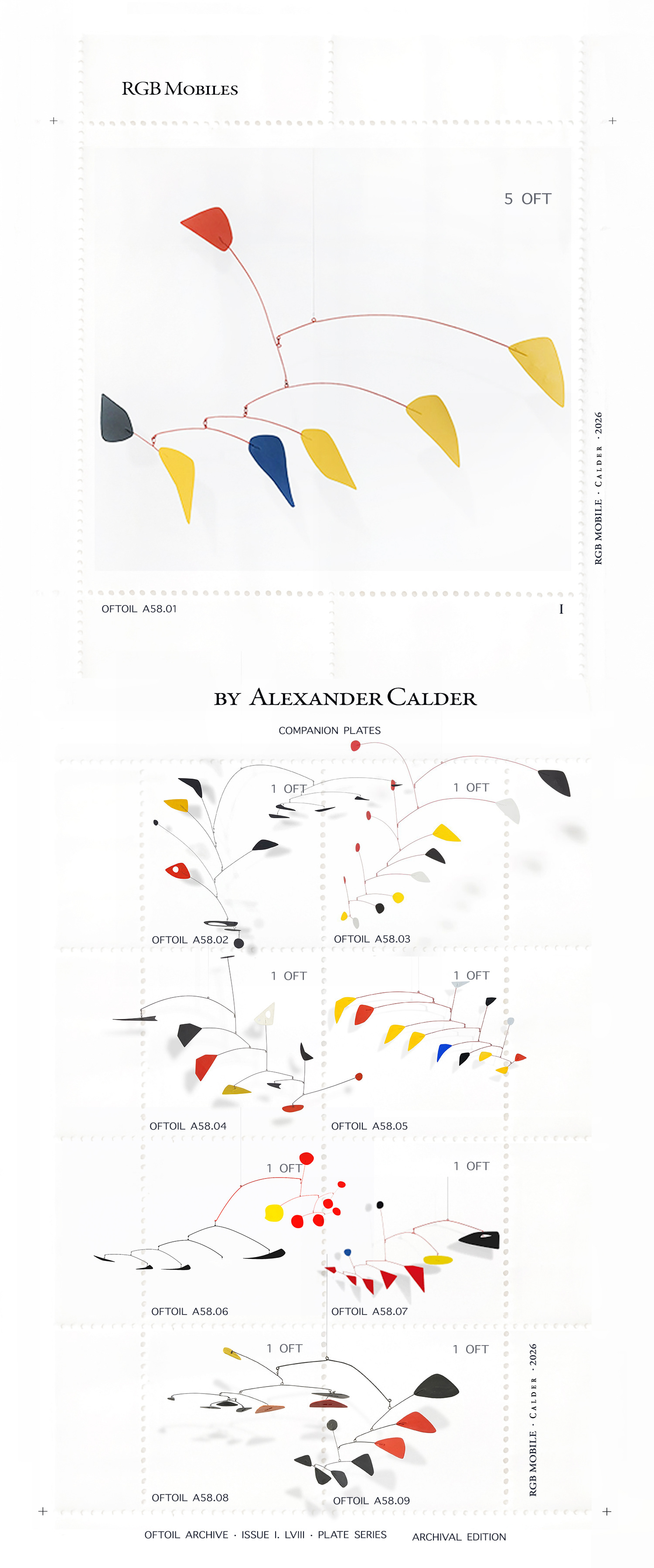
Primary colours appear here as structural forces rather than decoration. Red, yellow, and blue establish visual tension across an otherwise weightless field, each element contributing to an invisible equilibrium that extends beyond the frame.
The composition reveals Calder’s remarkable ability to make engineering appear effortless. Every curve, suspension point, and interval suggests motion before movement occurs, allowing colour to become a measure of balance rather than emphasis.
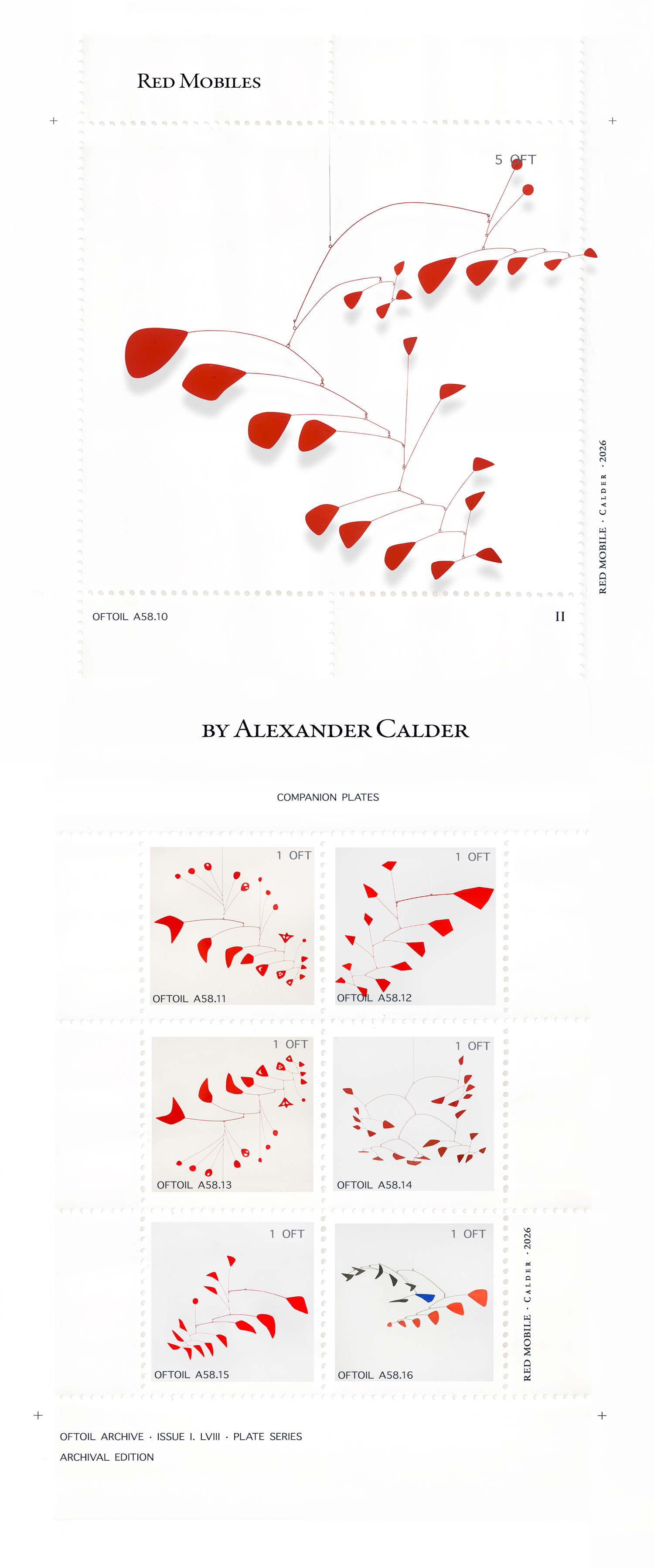
By reducing the palette almost entirely to red, the mobile becomes an exploration of rhythm through repetition. Individual forms lose their identity and instead participate in a continuous visual cadence, unfolding across space like notes in a silent composition.
The restraint of colour amplifies the delicacy of structure. What initially appears simple gradually reveals an intricate choreography where asymmetry, tension, and suspension coexist in perfect proportion.
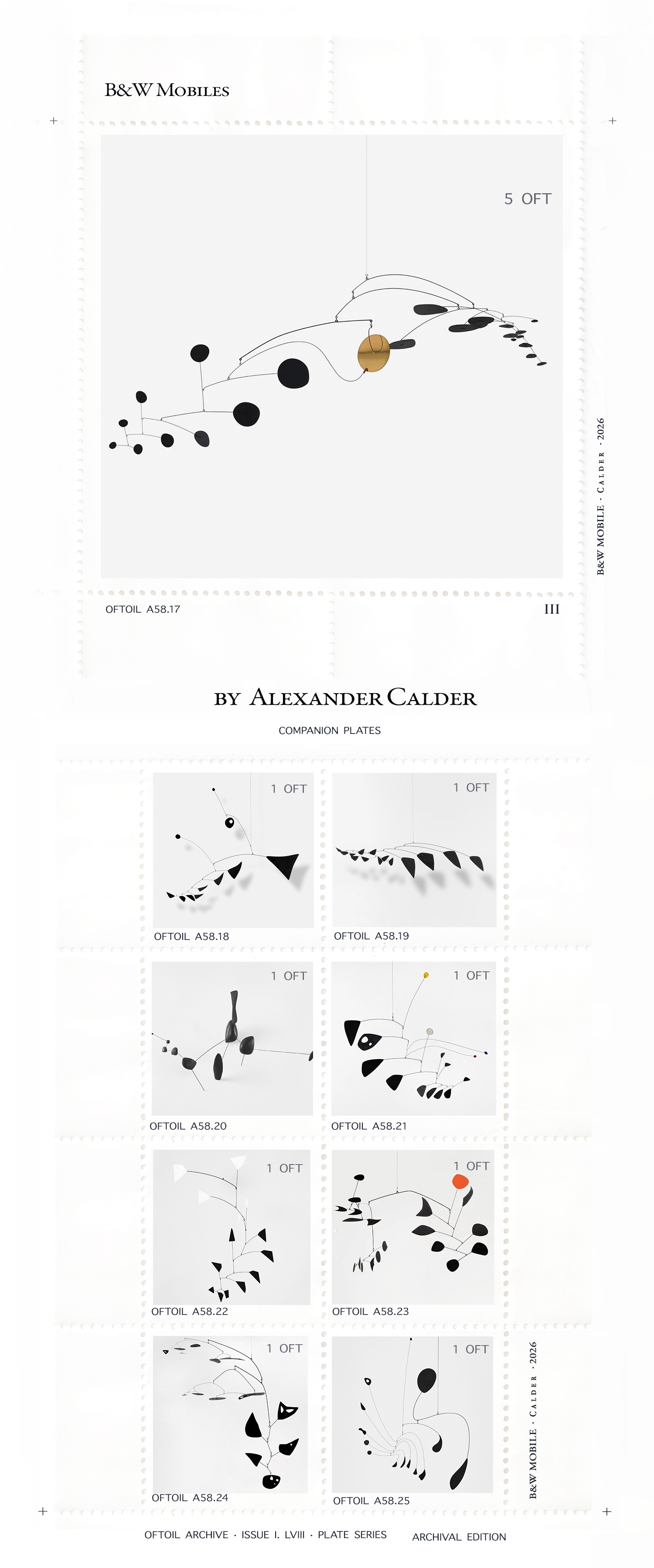
Without the distraction of colour, form assumes complete authority. Black elements punctuate the surrounding space while occasional metallic accents introduce moments of quiet luminosity, allowing balance itself to become the primary subject.
These compositions demonstrate Calder’s extraordinary understanding of negative space. The intervals between objects are as carefully considered as the objects themselves, creating sculptures that are defined as much by absence as by presence.
More than kinetic sculptures, Calder’s mobiles propose a different understanding of order—one in which stability is achieved through continuous adjustment rather than permanence. Their elegance lies not in resisting movement, but in embracing it with remarkable precision.
Within this archival edition, the companion plates revisit that enduring language of suspension, reminding us that the lightest gesture can often possess the greatest structural intelligence.
Images courtesy of Alexander Calder.