
“Glass is the most magical of all materials. It transmits light in a special way.”
— Dale Chihuly
— Dale Chihuly
Few contemporary artists have transformed glass from a functional material into an immersive language of sculpture as profoundly as Dale Chihuly. For more than five decades, his practice has challenged conventional expectations of symmetry, permanence, and utility, allowing molten glass to respond naturally to gravity, heat, and gesture. Rather than treating the medium as a vehicle for technical perfection, Chihuly embraces its capacity for movement, irregularity, and color, producing forms that appear simultaneously ancient and futuristic.
Working collaboratively with teams of master glassmakers, Chihuly has developed a succession of distinctive series—each exploring a different conversation between material, process, and light. Soft Cylinders, Ikebanas, Persians, Baskets, and Chandeliers are not isolated collections but chapters within an evolving vocabulary, where ideas migrate from one family of objects to another. Throughout these bodies of work, glass becomes less an object than an environment, transforming surrounding space through reflection, transparency, and luminous color.
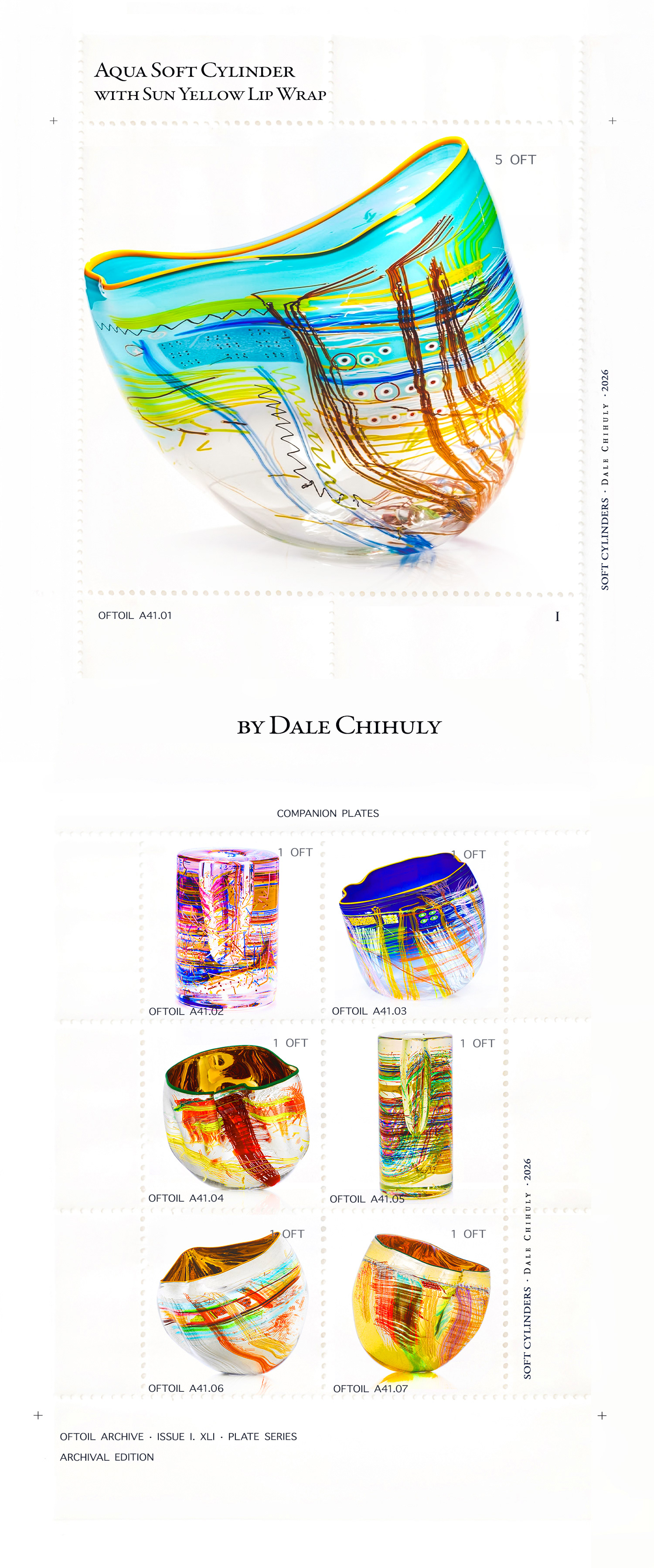
The Soft Cylinders series brings together two pivotal directions in Chihuly’s practice. It combines the intricate glass-thread “pick-up drawing” developed for the Cylinders with the relaxed asymmetry and gravity-shaped profiles first explored through the Baskets. The resulting vessels appear almost weightless, their surfaces carrying floating linear compositions that become inseparable from the glass itself rather than decorative additions.
Each Soft Cylinder records a precise moment during fabrication, when molten glass rolls across prepared thread drawings and permanently fuses them into the vessel. Gravity then determines the final silhouette, ensuring every object remains unique despite belonging to the same formal family. The series demonstrates Chihuly’s enduring fascination with weaving, drawing, and spontaneous movement translated into glass.

Named after the Japanese tradition of flower arrangement, the Ikebanas return floral gestures to the vessel after years in which Chihuly’s forms increasingly escaped conventional containers. Rather than illustrating botanical subjects, these works reinterpret the relationship between vessel and bloom, allowing elongated stems, twisting tendrils, and radiant blossoms to become sculptural extensions of blown glass.
The series reflects Chihuly’s long engagement with Japanese aesthetics, where balance arises through asymmetry, negative space, and the dialogue between natural forms and crafted objects. Every composition celebrates growth rather than containment, transforming glass into a medium capable of expressing botanical vitality without sacrificing its inherent transparency.

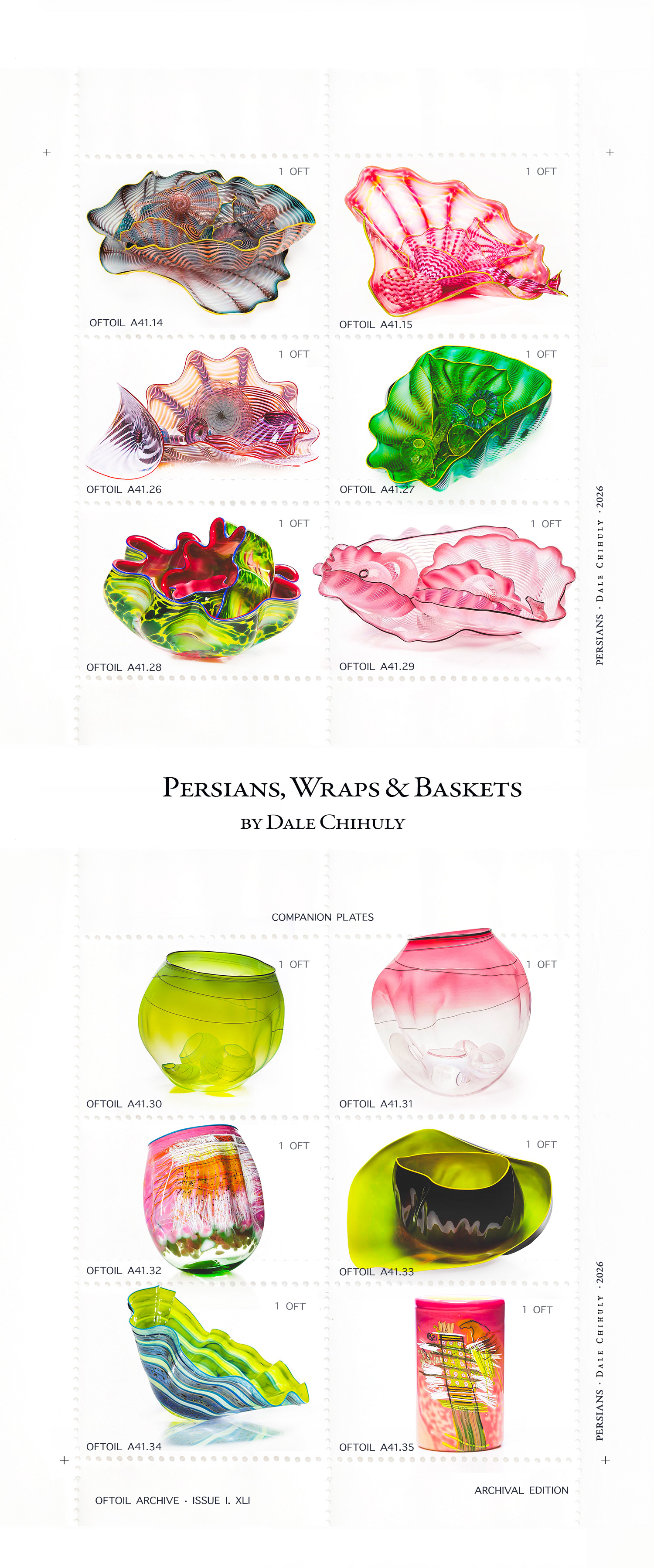
Among Chihuly’s most celebrated bodies of work, the Persians explore the expressive potential of open vessels through dramatically flared rims, saturated color, and rhythmic body wraps. Although the title evokes the cultural memory of ancient Persia, Byzantine glass, and Near Eastern ornament, the works remain contemporary abstractions whose references are poetic rather than archaeological. Chihuly himself described the name as one that simply evoked distant cultures, trade routes, gardens, and wonder.
Displayed individually or in nested groupings, Persians blur distinctions between vessel and sculpture. Their undulating edges suggest shells, flowers, waves, or textiles, while repeated installations transform individual objects into immersive environments. Together with the Baskets, they represent a decisive departure from traditional symmetry, allowing gravity, color, and improvisation to become primary compositional forces.
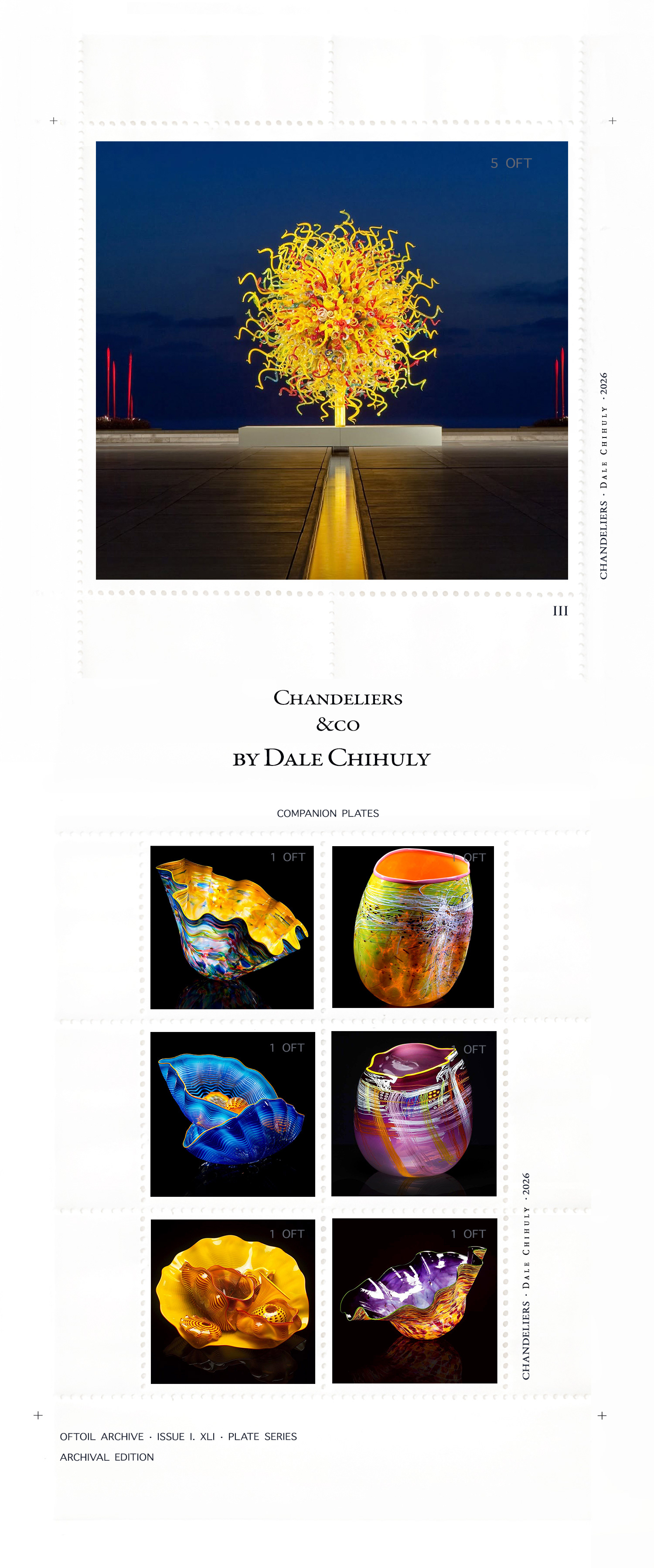
The monumental Chandeliers extend Chihuly’s vocabulary from the tabletop into architectural space. Composed from hundreds or even thousands of individually blown elements, these suspended sculptures dissolve the historical function of the chandelier while preserving its relationship with illumination. Rather than supporting light, the glass itself becomes its source of visual energy through reflection, transparency, and accumulated color.
The companion works presented alongside the installations reveal how ideas migrate freely across Chihuly’s practice. Motifs originating in Persians, Baskets, Macchia, and Cylinders reappear at different scales, demonstrating that each series is part of a broader ecosystem rather than an isolated collection. Monumentality emerges not from size alone but from the cumulative language developed over decades of experimentation.
Archival Note
Across every series, Dale Chihuly treats glass as a living material rather than a finished surface. Gravity, heat, and collaboration become active participants in the making of each object, allowing chance to coexist with extraordinary technical control. His vessels remain recognisable as functional archetypes while continuously resisting function, existing instead as studies in movement, color, and light.
Taken together, these collections reveal a practice rooted equally in material history and contemporary imagination. References to weaving, Japanese floral traditions, ancient vessels, architectural ornament, and natural forms are transformed into works that transcend their origins, demonstrating how craft can evolve into environmental sculpture while retaining an intimate connection to the hand and the furnace.
Images courtesy of respective owners.


