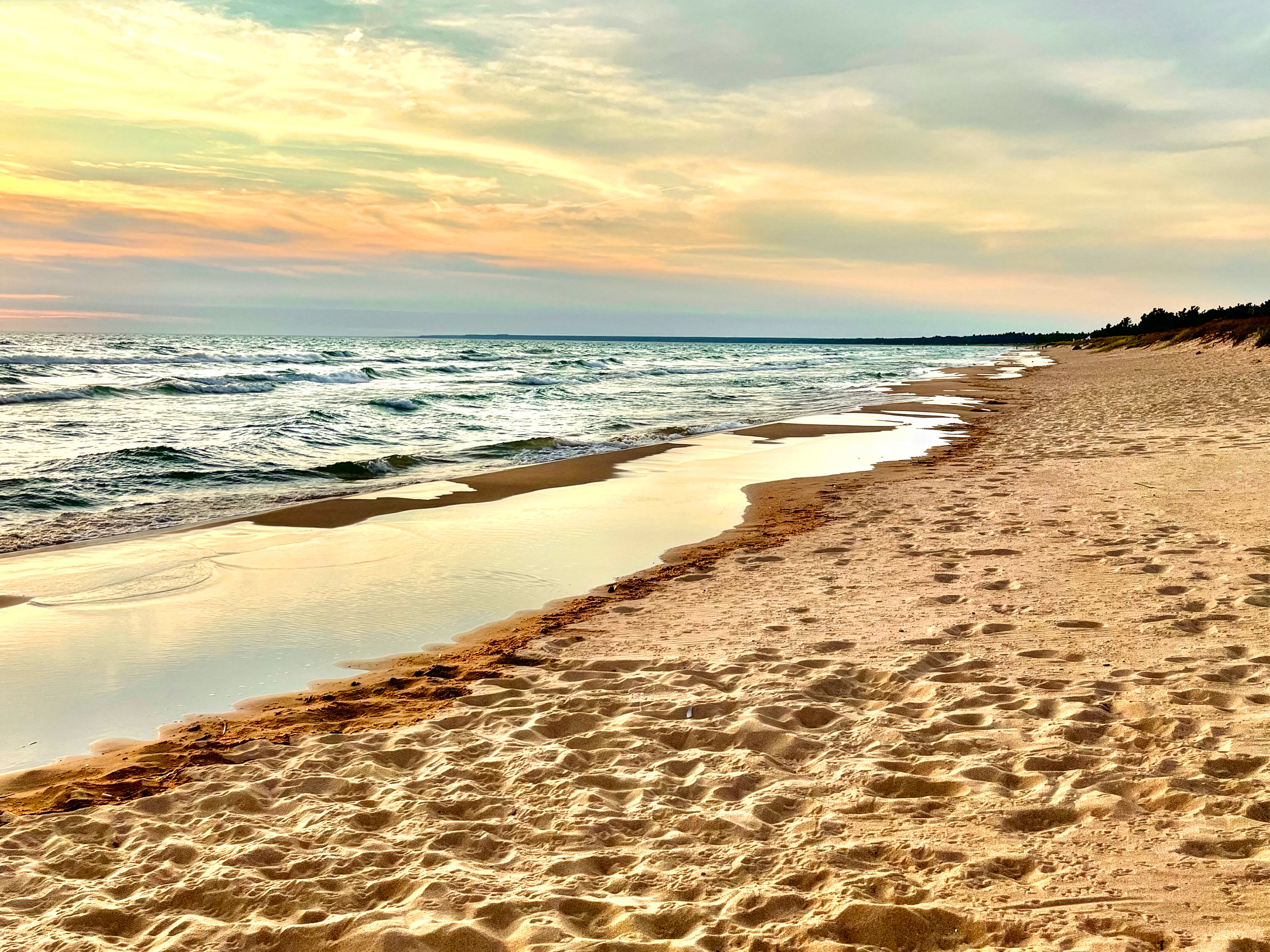
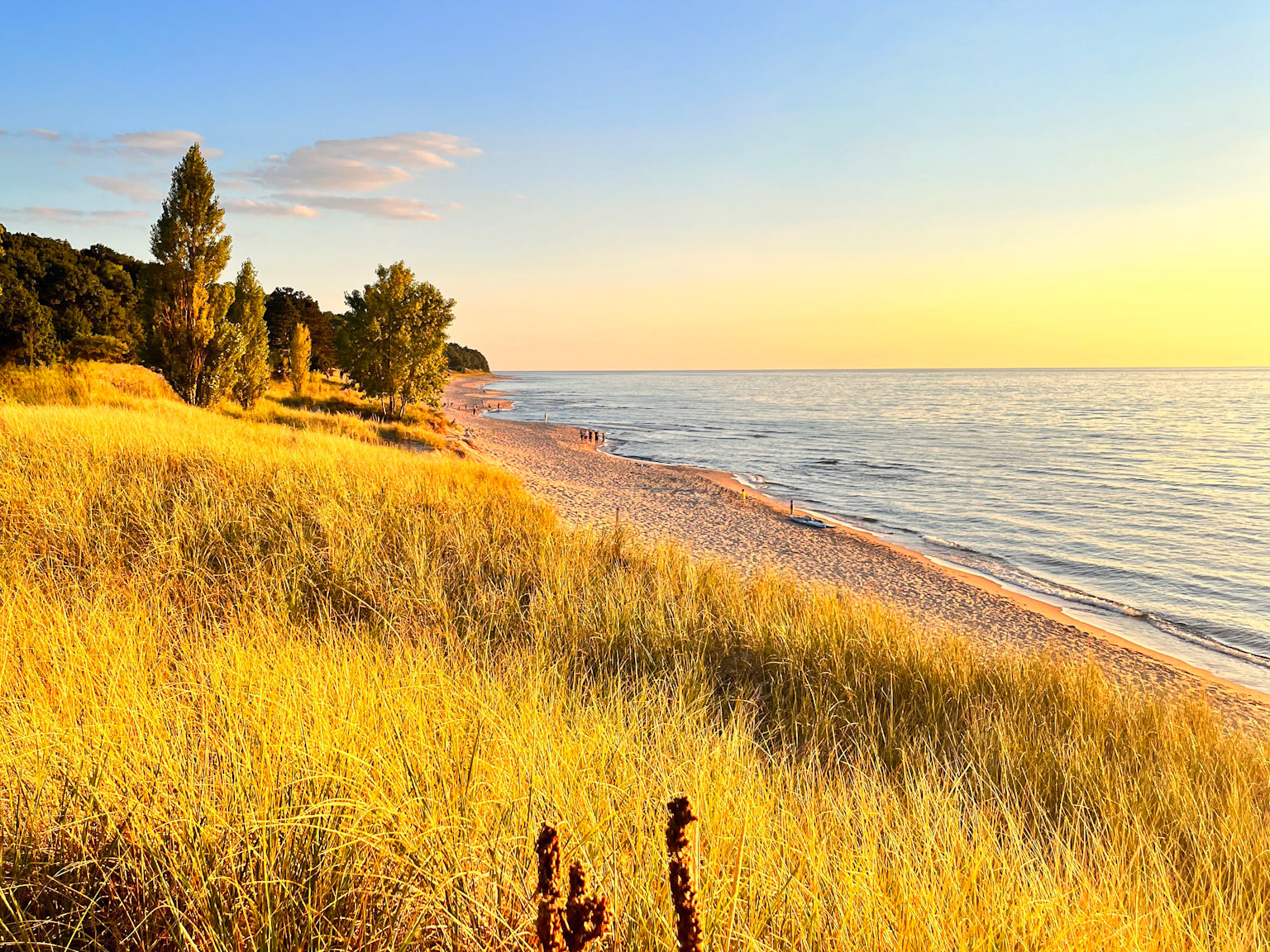
There are stretches of shoreline that feel almost mythic—places where the atmosphere behaves as if guided by an older script, a quieter physics. The northernmost edge of Lake Michigan is one of them. Here, facing south toward a distant Chicago that dissolves into the arc of the horizon, the light takes on an uncanny warmth: not the pastel gentleness of mid-lake, nor the crystalline coolness of Superior, but a molten, honey-steeped radiance that seems to rise from the water rather than fall from the sky.
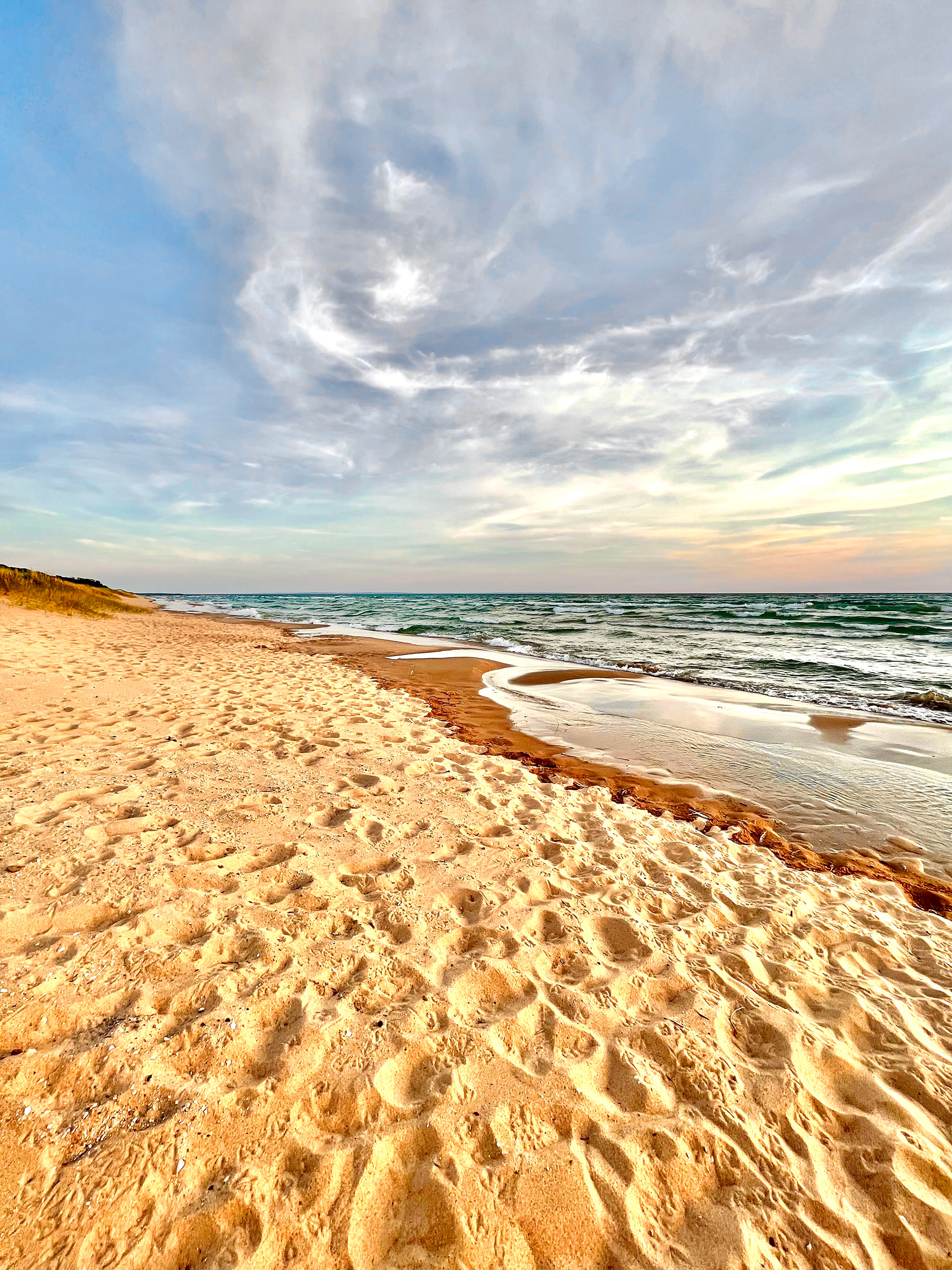
At this latitude, the waves travel differently. They carry a slower, heavier cadence—as though the lake itself is drawing breath from deeper chambers, sending each line of surf to the sand with a kind of hesitant insistence. The shoreline holds their rhythm in soft relief: intricate constellations of footprints, wind-scalloped dunes, and the shimmer of tidal runnels that catch the evening sun like strips of liquid metal. It’s a coastline that reveals its textures in motion, sculpted moment by moment by a body of water that feels unusually alive.
The palette is astonishing. Amber and apricot flare across the surface, dissolving into violet smoke. The water becomes a vast sheet of brushed gold, then silver, then a thin horizon of pale fire. Even the sand seems illuminated from within. For a moment—long enough to forget time—the entire landscape behaves like a slow-moving photograph developing in real air.
There is nothing extravagant here, nothing clamoring for attention. The elegance lies in restraint: a solitary shoreline, an unbroken horizon, the warm hush of an evening that feels both intimate and impossibly expansive. It’s the kind of scene a fictional coastal magazine—some imagined title glinting between Vogue and Condé Nast Traveller—would devote an entire spread to. A place where the Midwest stops being landlocked and becomes, quite simply, sublime.